


MELILLA
IN MOTION
MELILLA IN MOTION is a civic design project developed at the Norman Foster Institute by a stellar team of seven, drawn from diverse backgrounds across the world.
Melilla is a European city on North African soil, a plural society of five communities living side by side, fractured by isolated neighbourhoods and uneven access to public life. Melilla in Motion reimagines it as a Caring City, using Play as the common ground every community already shares.
THE CARING CITY
A caring city is one that looks after itself and its people, where daily life meets a practice of mutual diligence, as people, buildings and public spaces sustain one another through presence. Care is not only confined to institutions, but woven into the everyday encounters. While a coherent urban structure helps citizens find their way in movement, it is the public space that invites connection, interaction and cordiality between the people regardless of their background, beliefs, or gender identity. The works of famous urbanists, such as Jane Jacobs, David Lynch, Juliet Davis, have inspired outlining a framework for cities that are safe, inclusive and intelligible.
For Melilla, we imagine the city as a living embodiment of these ideas, coupled with our vision of a social catalyst that brings communities together, encouraging movement, dialogue and solidarity. Inspired by Melilla’s diverse identity, institutional priorities and its rich network of public sports facilities, Melilla in Motion (Melilla en Movimiento) seeks to address the challenges impeding integration and progress, while cultivating a culture of care that strengthens the city’s future.
GEO-INTELLlGENCE
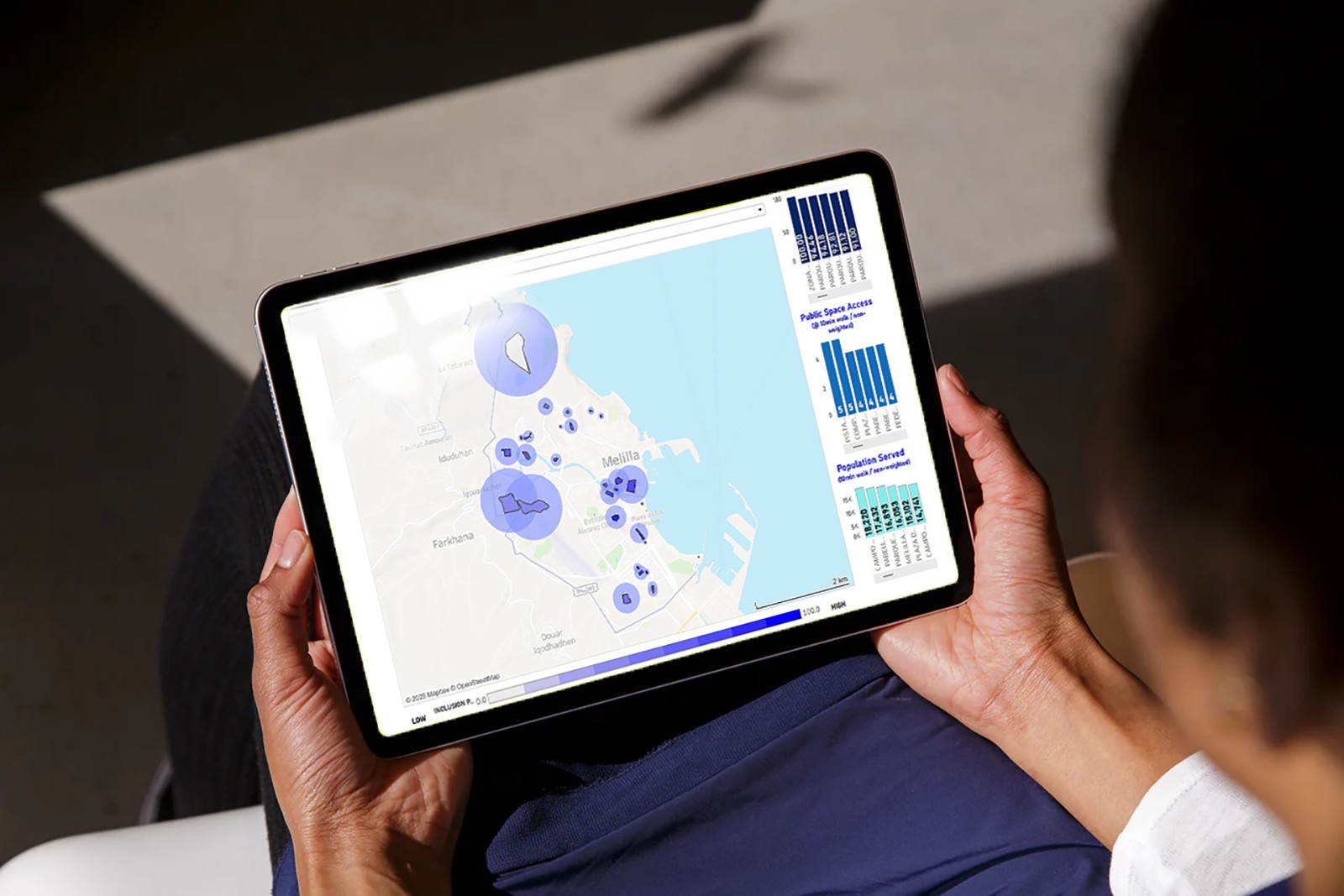
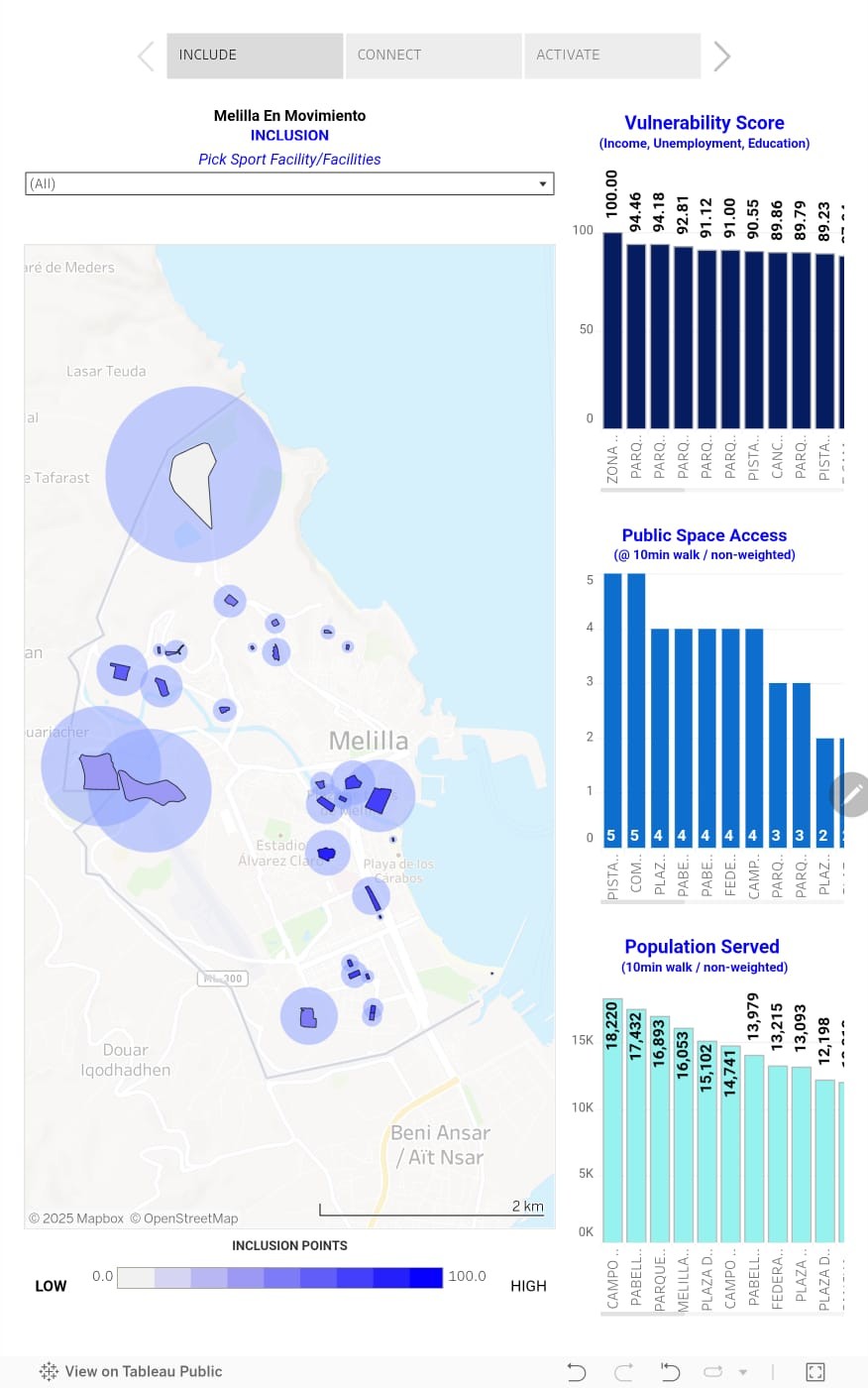
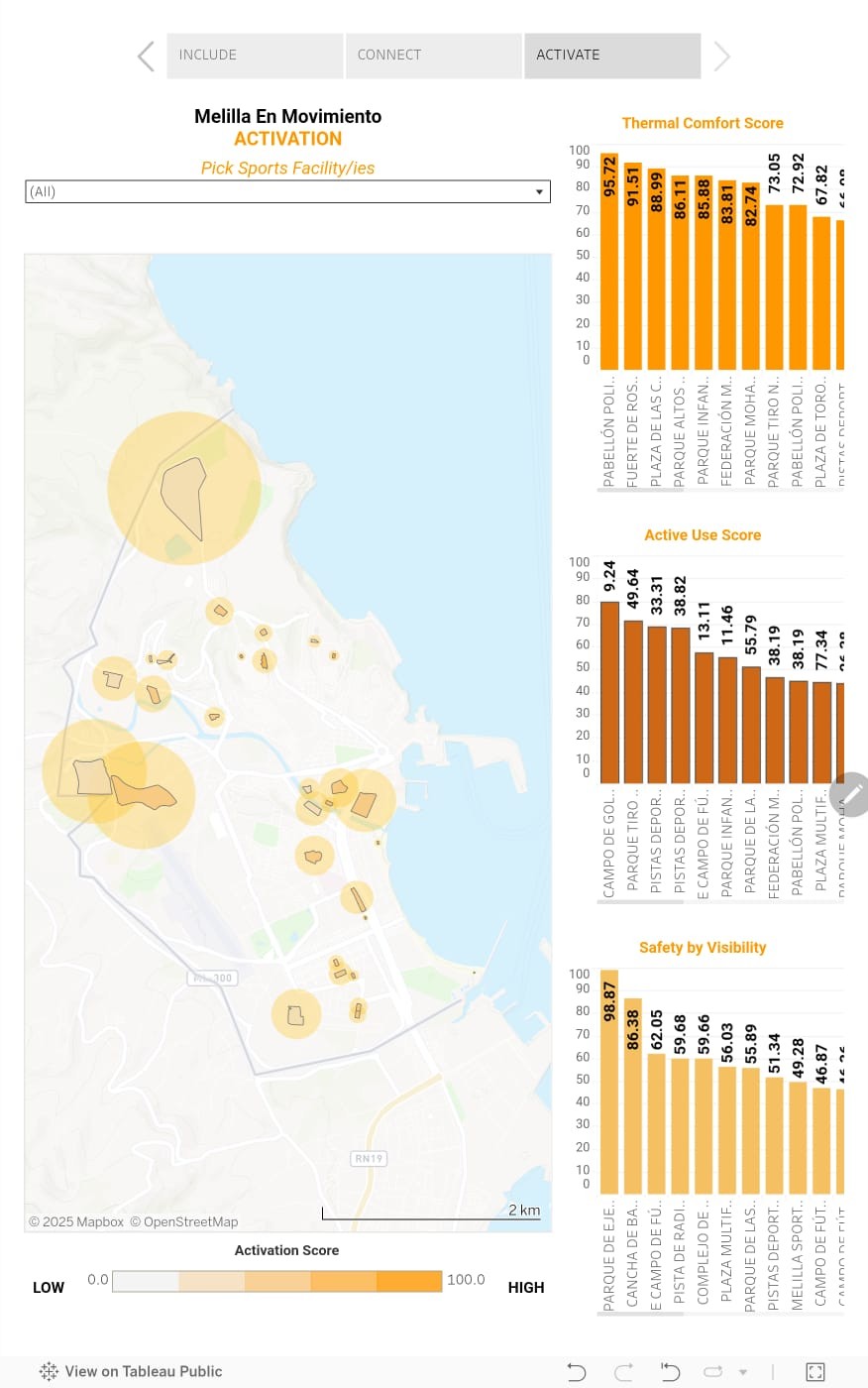
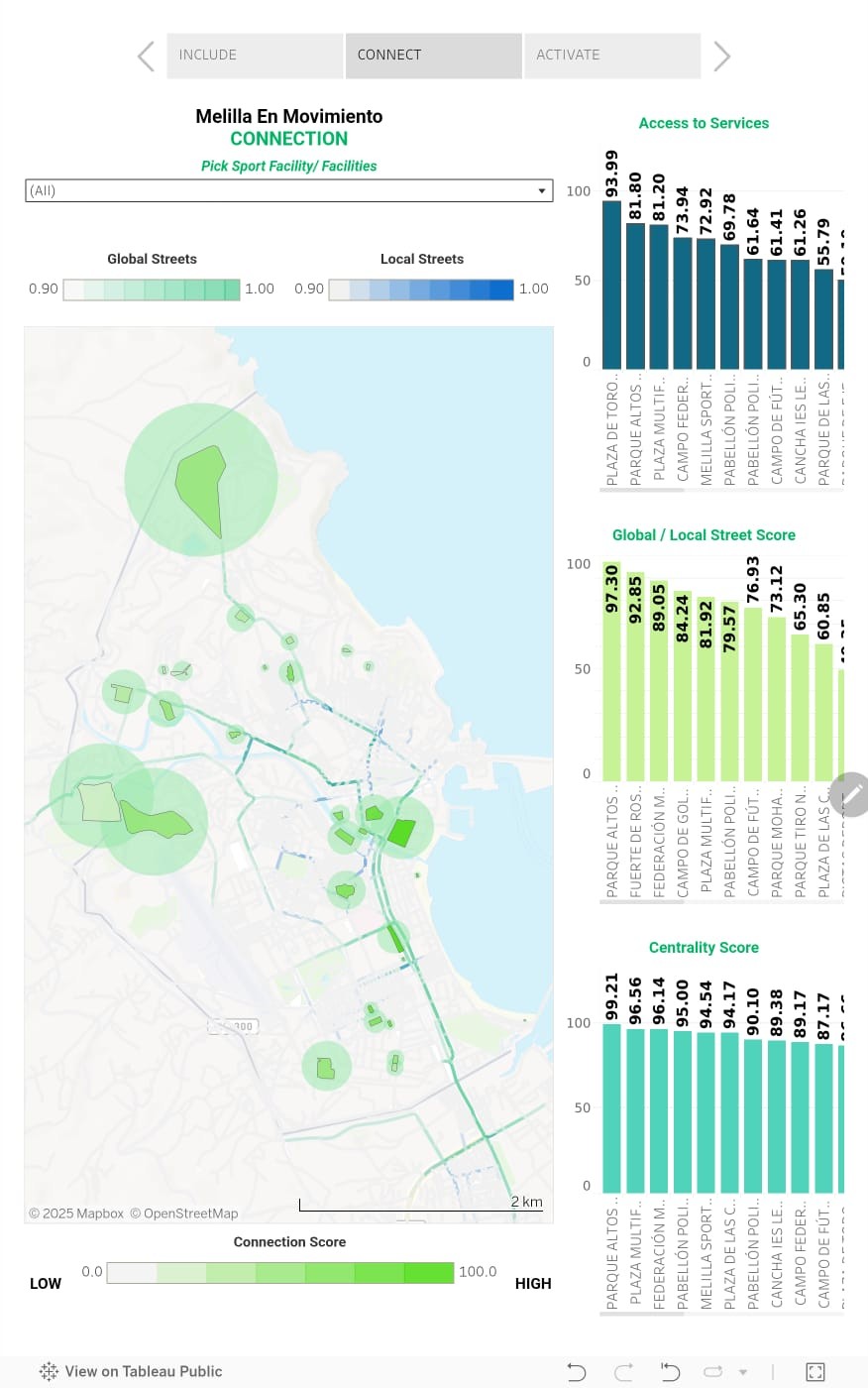
Effective urban interventions begin with a deep understanding of context. Building on open-source data, insights from community workshops, the immersive site visit and spatial analytics, we developed the Node Assessment Tool to evaluate the condition and potential of Melilla’s sports infrastructure. The tool consolidates qualitative and quantitative findings into a clear set of Key Performance Indicators (KPIs), enabling the team to measure, compare and prioritise sites with precision. They are visualised in a three-page dashboard structured around three strategic pillars: Inclusion, Activation, Connection. Users can select any sport facility to view its scores, compare multiple sites and explore spatial relationships across the city through maps and bar charts.
Inclusion
Provides quantitative scores for the physical quality of the sports facility and its surroundings, including median thermal comfort, safety perception based on visibility and usage based on the city's yearly calendar of activities.
Activation
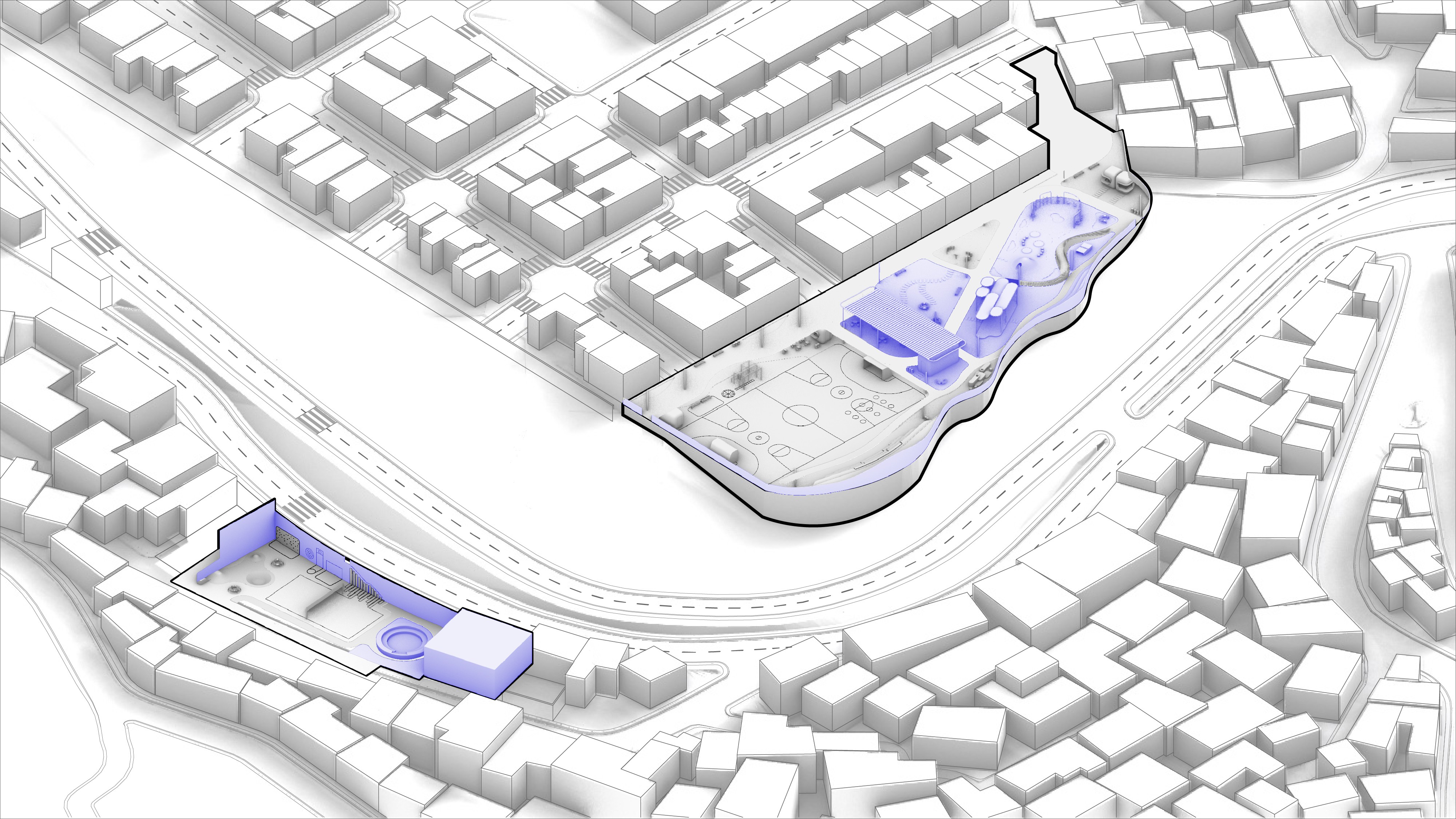
Consolidates the scores of each sport facility based on the KPIs: Vulnerability, Access to Public Open Space and Population Served.
Connection
Quantifies the KPI scores from Network Analysis based on Hillier Centrality Values, Choice Global / Local Streets and Accessibility to various services and public amenities.
978
DATA GATHERED IN GIGABYTES
CITY SIZE IN KM2
12.3
DENSITY / SQUARE KM2
7k
WALKING TIME IN HOUR
1:40
CIVIC-TECH
THE FIRST PIECE OF CIVIC INFRASTRUCTURE MELILLA RECEIVED WAS NOT PHYSICAL, BUT A TOOL, ONE THAT ALLOWS THE CITY TO DECIDE, AT SCALE, WHAT IS WORTH BUILDING AT ALL. A DATA-DRIVEN PRIORITIZATION ENGINE REPLACES POLITICAL INTUITION WITH CIVIC EVIDENCE, TRANSFORMING URBAN DECISION-MAKING INTO A TRANSPARENT, DEFENSIBLE ACT OF DESIGN.
Each pillar is evaluated through a series of innovative KPIs that translate complex datasets into actionable insights for site selection and prioritisation.
Measuring Activation
I.

Measuring Inclusion
II.
Measuring Connection
III.
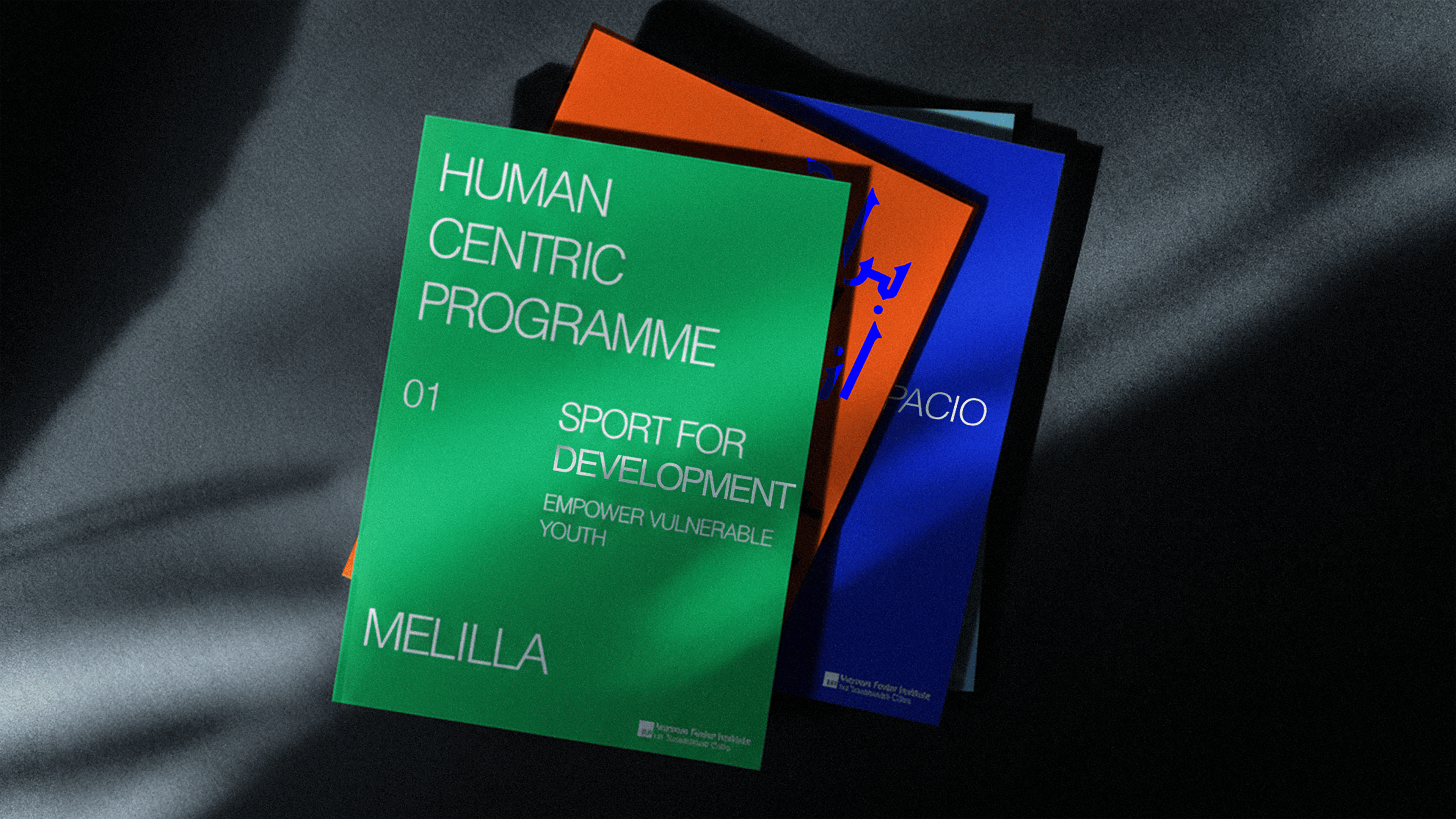
To ensure that Melilla’s new sports and public spaces remain active, welcoming and socially meaningful, a series of Human Centric Programmes has been developed. These initiatives include: Sports for Development (safe, structured sport activities supporting vulnerable youth), Makerspaces & Workshops (shared spaces for craft, repair and creative collaboration) and Time-Bank Exchanges (community-led systems for exchanging skills, care and support).
Each programme is designed to be easy to implement and is delivered through clear, multilingual booklets (Spanish and Arabic) that guide municipalities, educators and local associations.
AVERAGE AGE Y/O
YOUTH UNEMPLOYEMENT
36.5
36%
26%
UNDER 29 Y/O
34%
SCHOOL DROPTOUT YOUTH POP.
Human-centric programMES
In melilla our H.C.P are interventions designed around the daily lives, dignity, and agency of residents; treating public space, mobility and services as instruments of social cohesion rather than infrastructure delivery
SPORTS FOR DEVELOPMENT BECOMES a tool for protection, well-being and opportunity. Through after-school sessions, community sport groups, mentorship and vocational pathways, the programme uses play as an accessible entry point for young people.
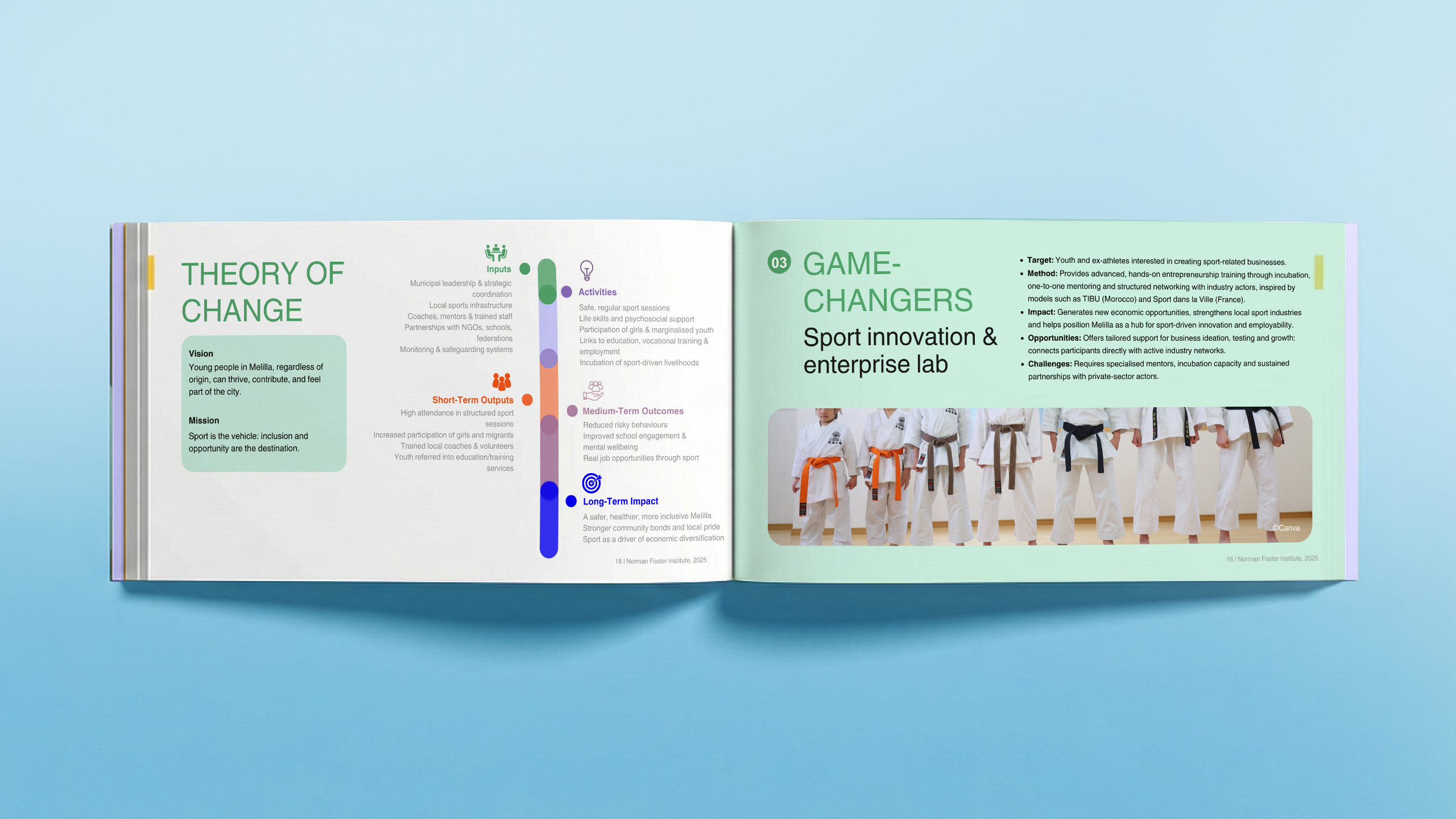
The Sports for Development Guidance Note is a practical resource for the city administration, outlining how sport can be structured as a pathway to development, protection and wellbeing for young people in Melilla. It gathers clear steps for programme design, beneficiary identification & neighbourhood implementation, supported by tools, good practices and global examples.
Alongside this, the note highlights a range of funding avenues, from EU inclusion and urban innovation programmes to national and philanthropic grants—helping the municipality translate sports activities into a coordinated, city-wide strategy for youth inclusion and community cohesion.
PARTICIPATIVE WORKSHOPS
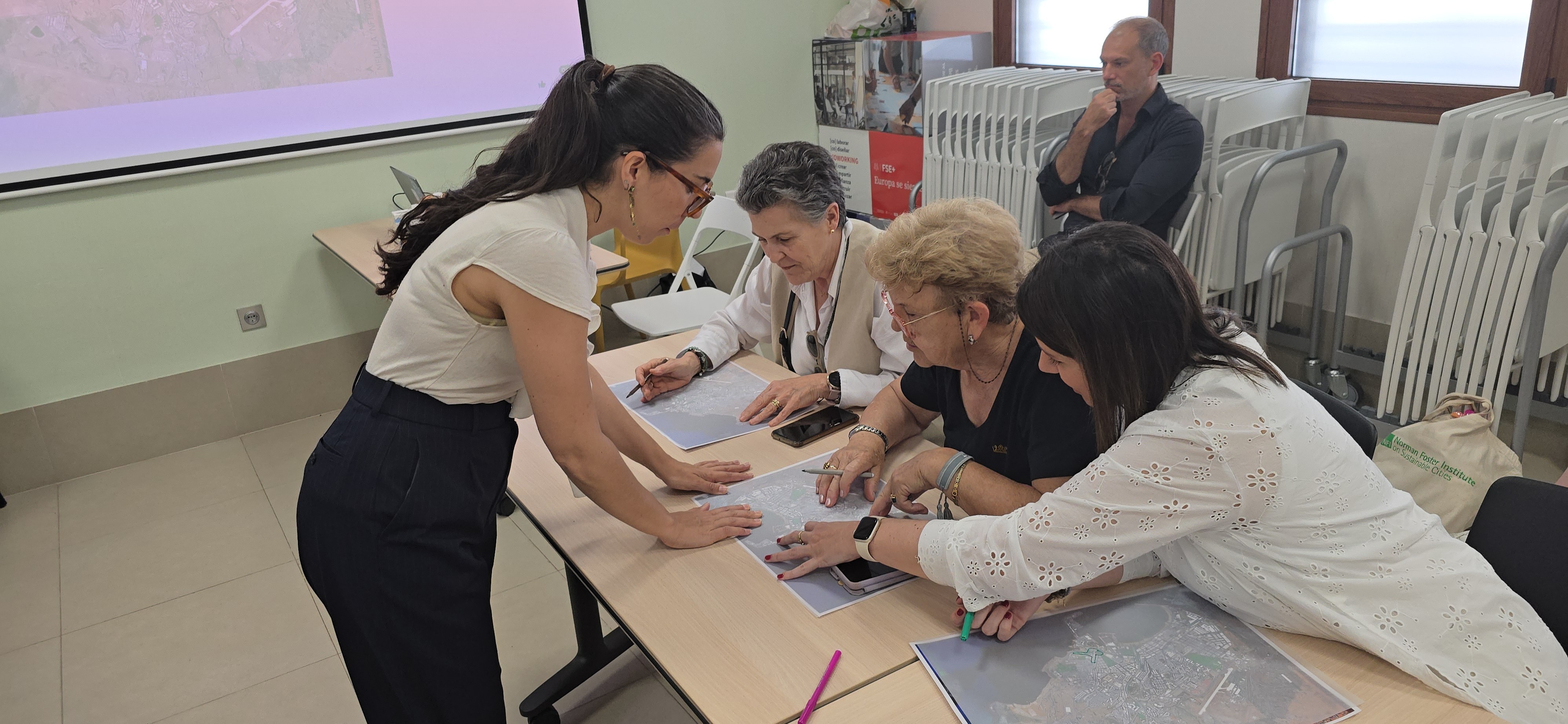
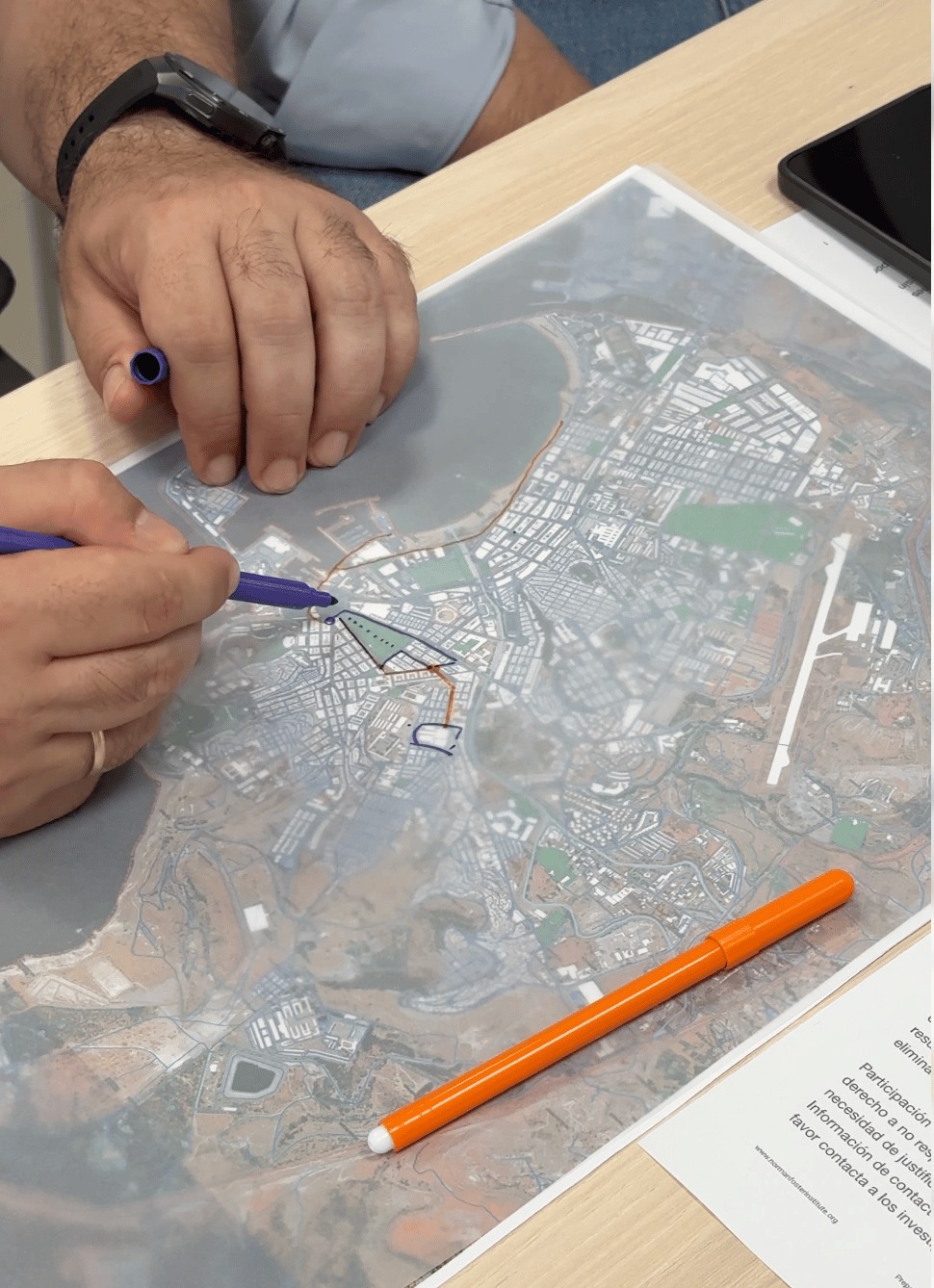
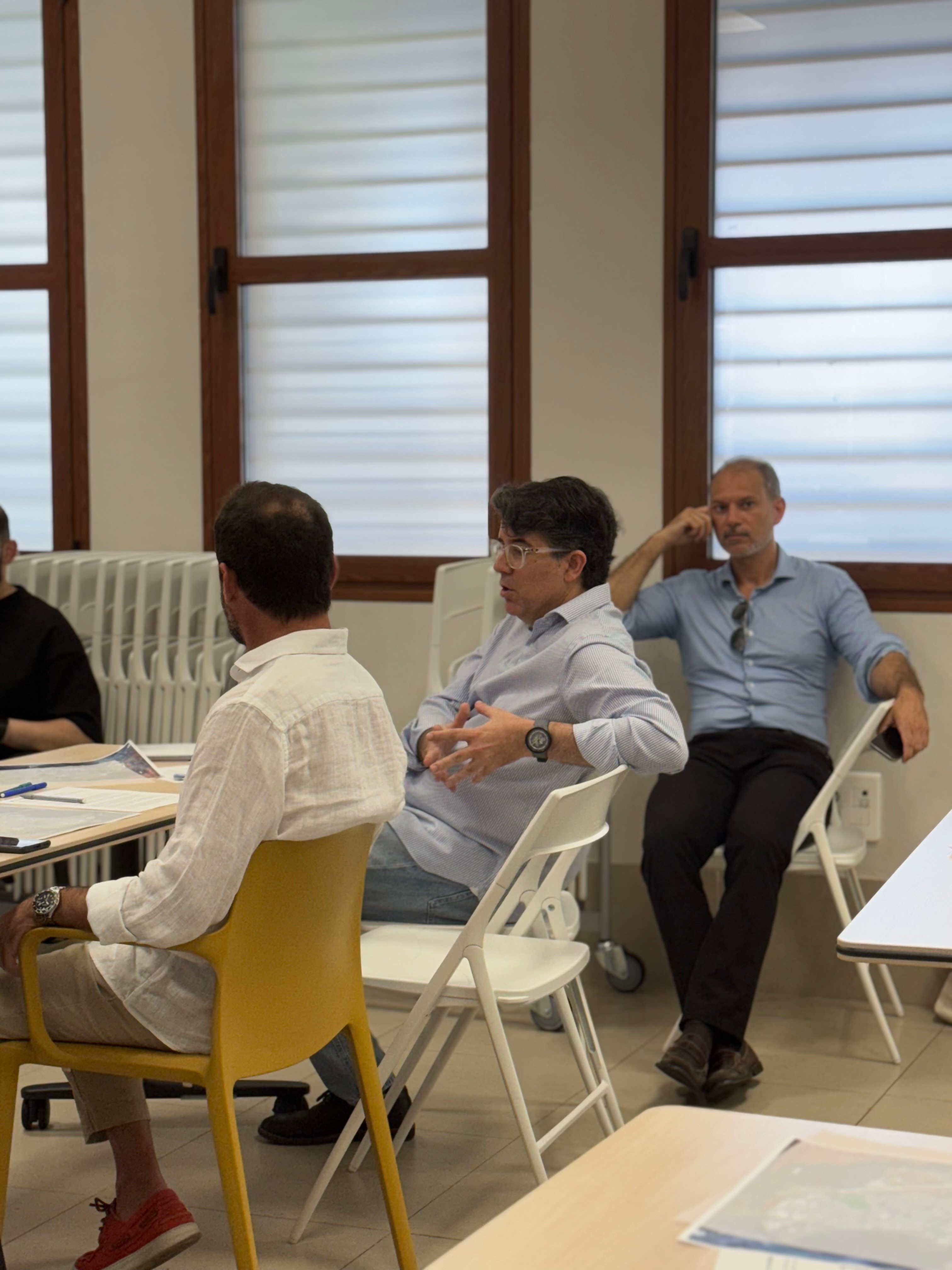
During our site visit, two participatory workshops were held to understand the needs, priorities and daily realities of Melilla’s residents. These sessions were our first experience with co-design and they became a defining part of the process. By listening directly to the people who live the city every day, we were able to ground our work in real voices, real concerns and real aspirations.
These workshops, developed through the NFI, created a space for dialogue and collaboration. This ensured that the project reflected not only a vision for the city, but also the communities who will shape and inhabit its future.
© 2025-2026 NFI
BRANDING AT THE CIVILIZATIONAL SCALE
branding acts as civic infrastructure: a shared visual language, drawn from Melilla's own heritage, that makes belonging legible across every public space. Its role is not to brand a city, but to give a plural city the common grammar through which all its communities can claim it together.
DESIGNING THE LANGUAGE OF PLAY
Melilla in Motion is not a brand applied to a city but a language designed for one. Its content is Play: the commons a plural city already shares, asking nothing of language, faith or origin. The system has six registers and they are one thing: the sports fields are its source, Melilla Antique its script, geometry and colour its vocabulary and grammar, wayfinding its plain public voice, the letter-shaped forms its inhabitable body, and the participatory workshops the means by which residents become its native speakers. Extracted from Melilla, written in its own hand, and handed back to the people who will keep it alive.
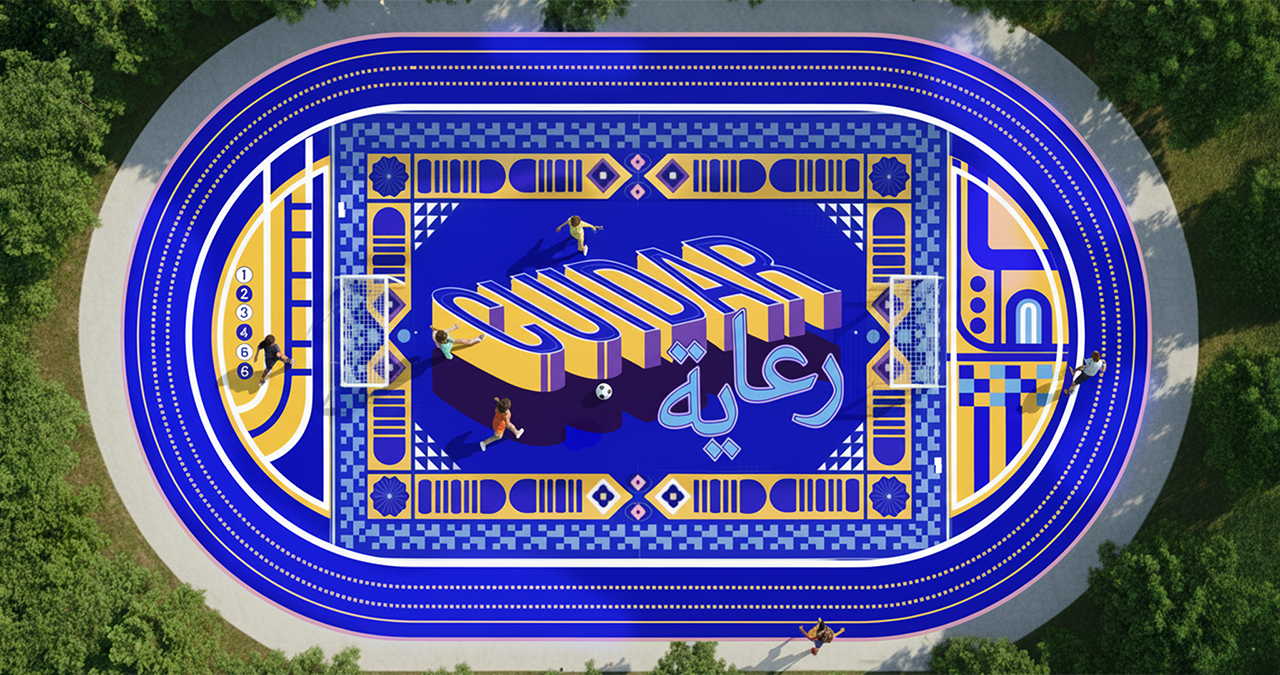

Sports fields draw geometry onto the ground: circles, grids, boundaries, arcs and directional lines. This catalogue extracts those essential shapes from football courts, athletics tracks, basketball courts and playgrounds, transforming functional markings into a system of visual identity.
Pictograms form a universal language that everyone can understand, matter their native language. This identity draws from the heritage of ceramic tiles craftsmanship with its geometric grids and ornamental precision. Inspired by the cultural legacies of Spain and Morocco where pattern becomes language and sport becomes culture.
Sport’s fields
I.
Tailored Typeface
III.
Wayfinding System
IV.
Curating Melilla In Motion
V.
URBAN INTERVENTION
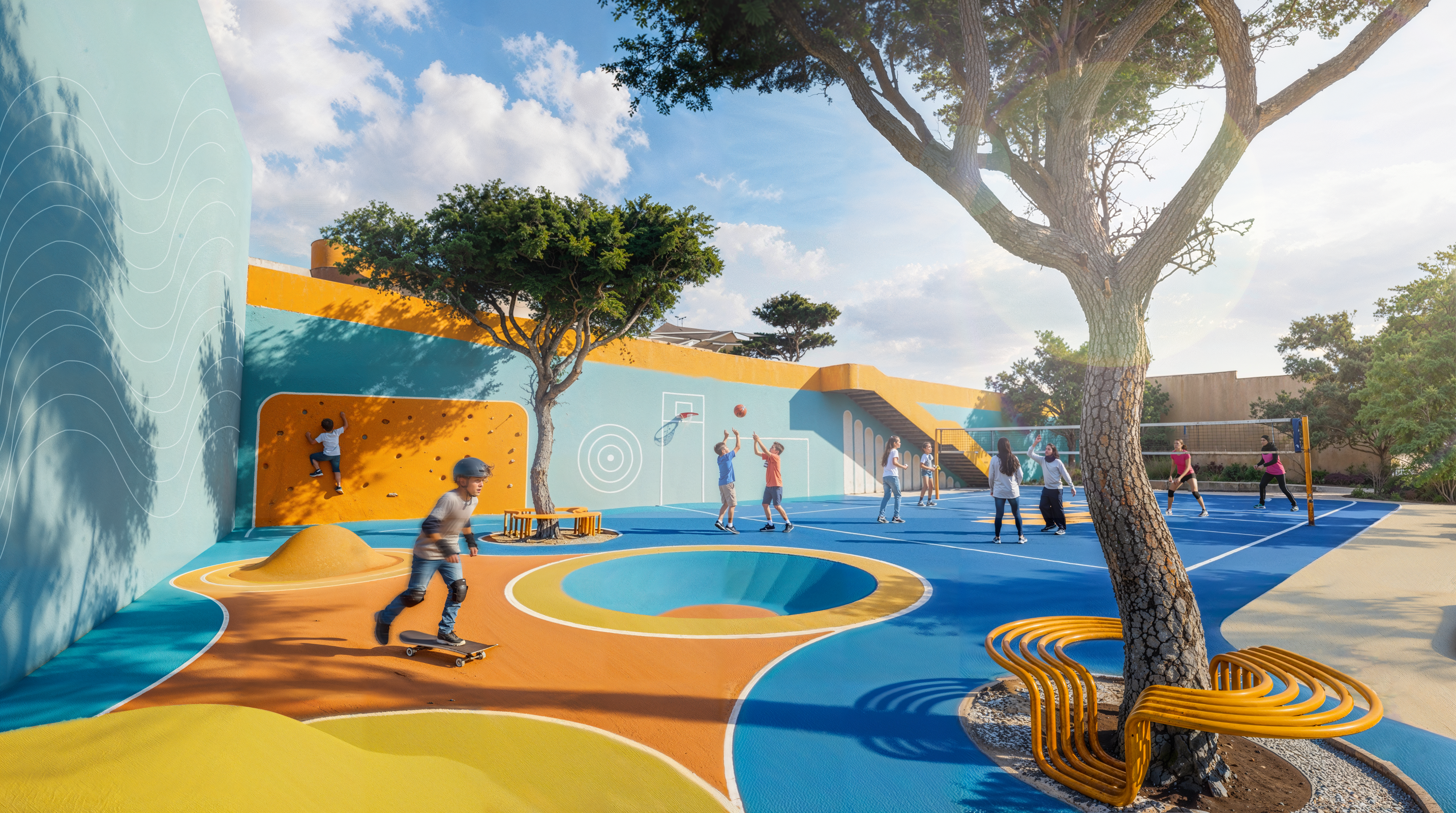
The urban design process takes into consideration the existing sports infrastructure that the city has previously invested in, by introducing diverse public space infrastructure to reinforce local engagement and space vibrancy.
WALKING TIME IN MN
BEFORE INTERVENTION:
WALKING TIME IN MN
AFTER INTERVENTION:
17
5
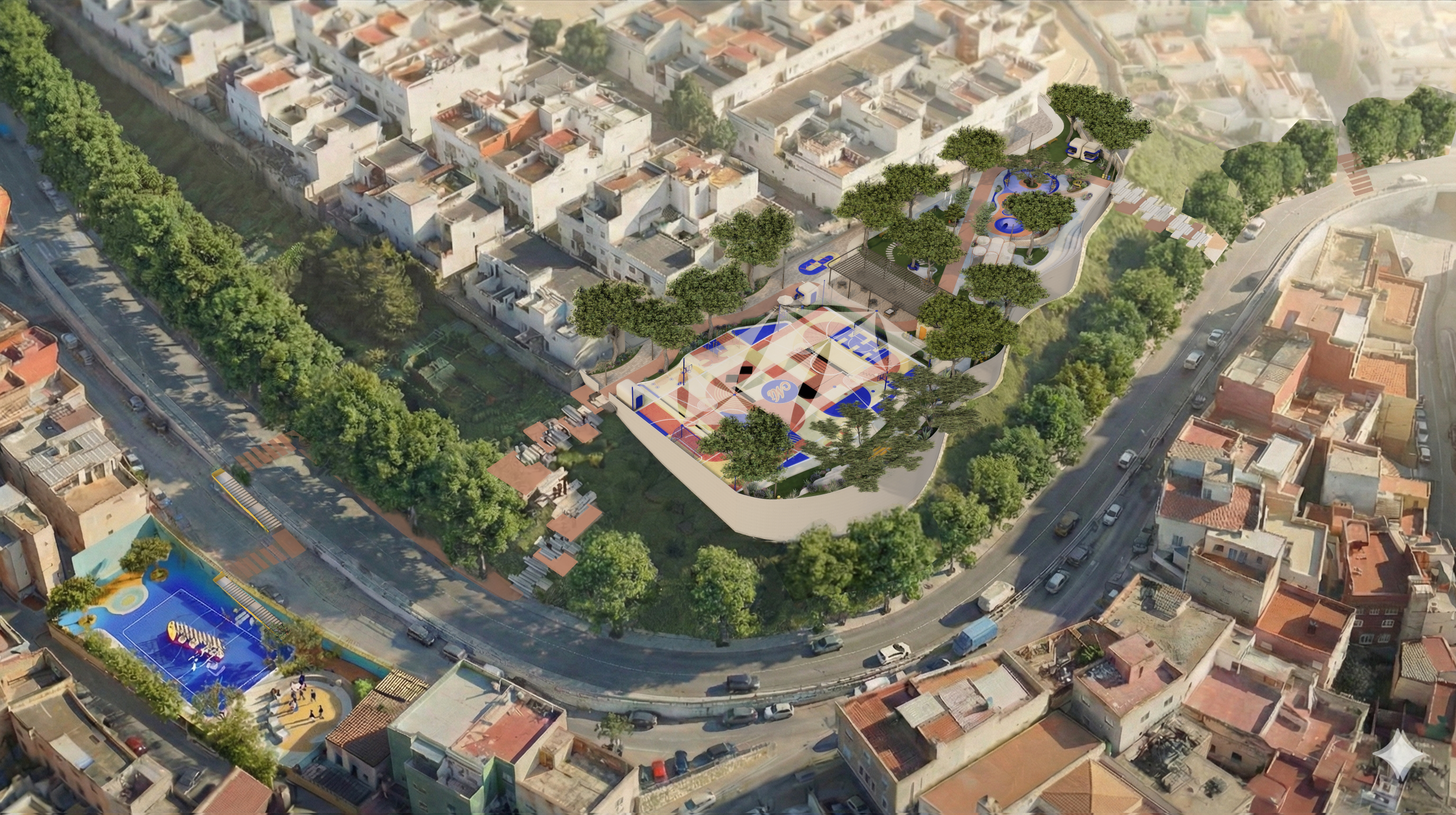
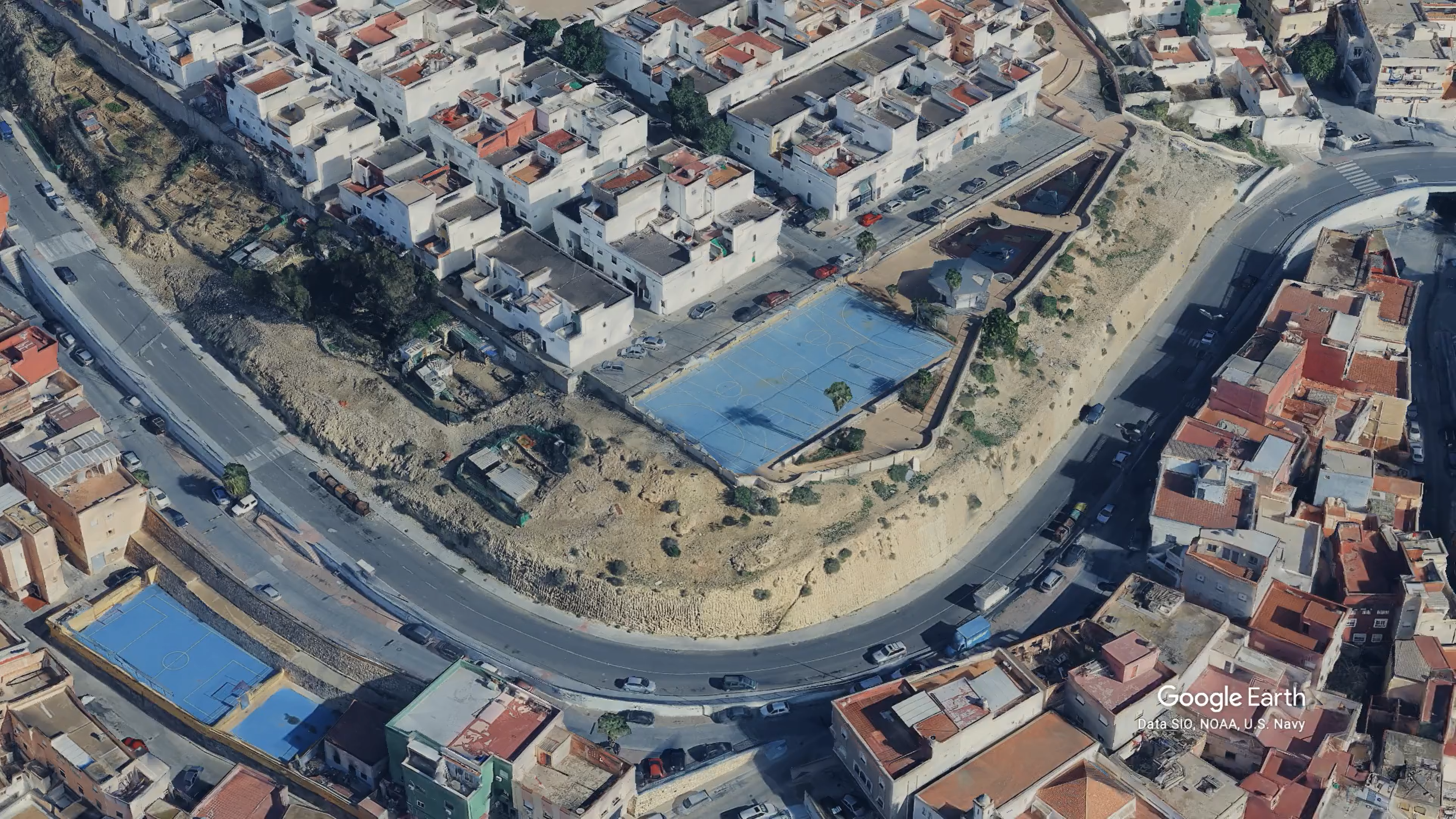
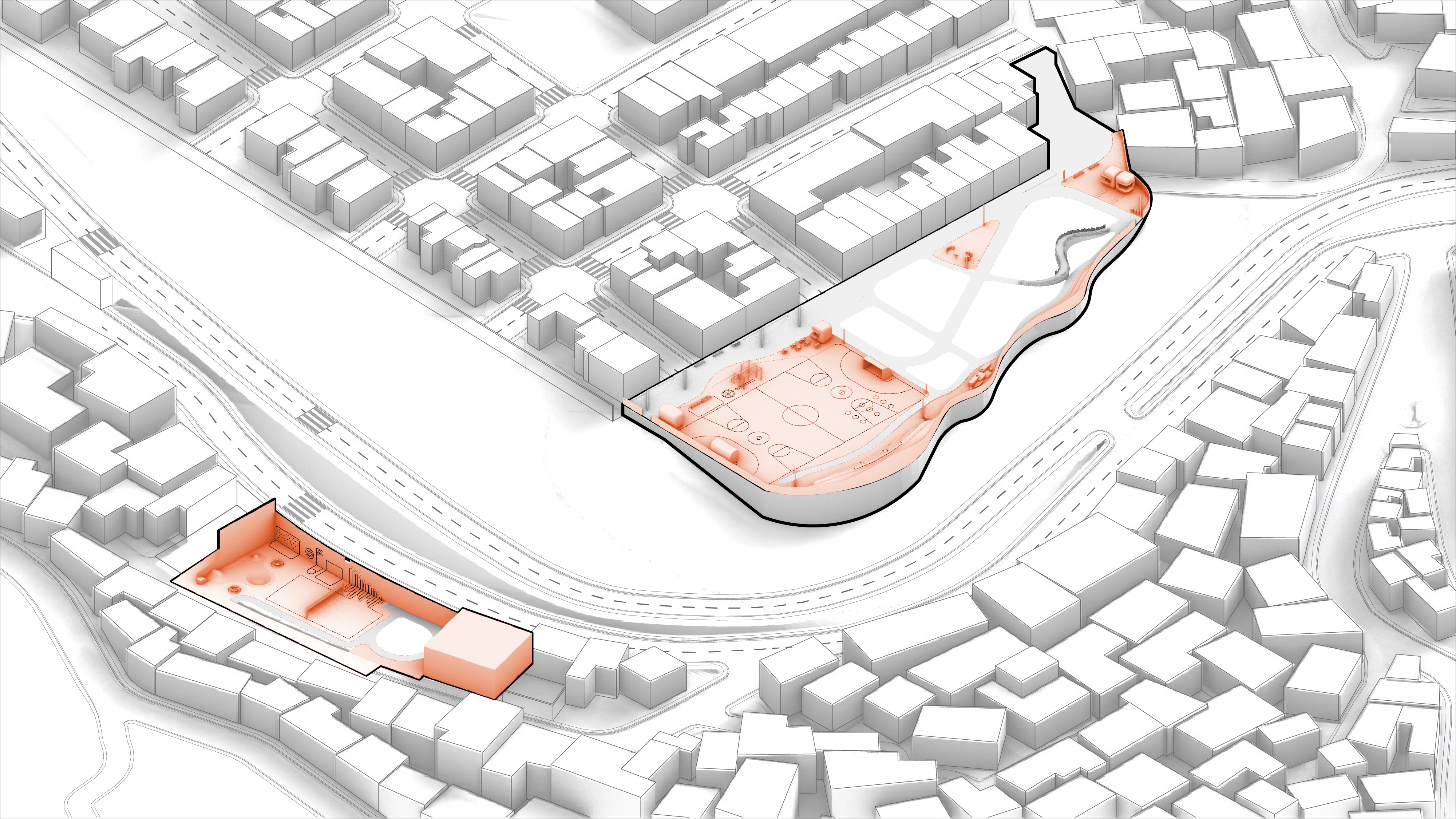
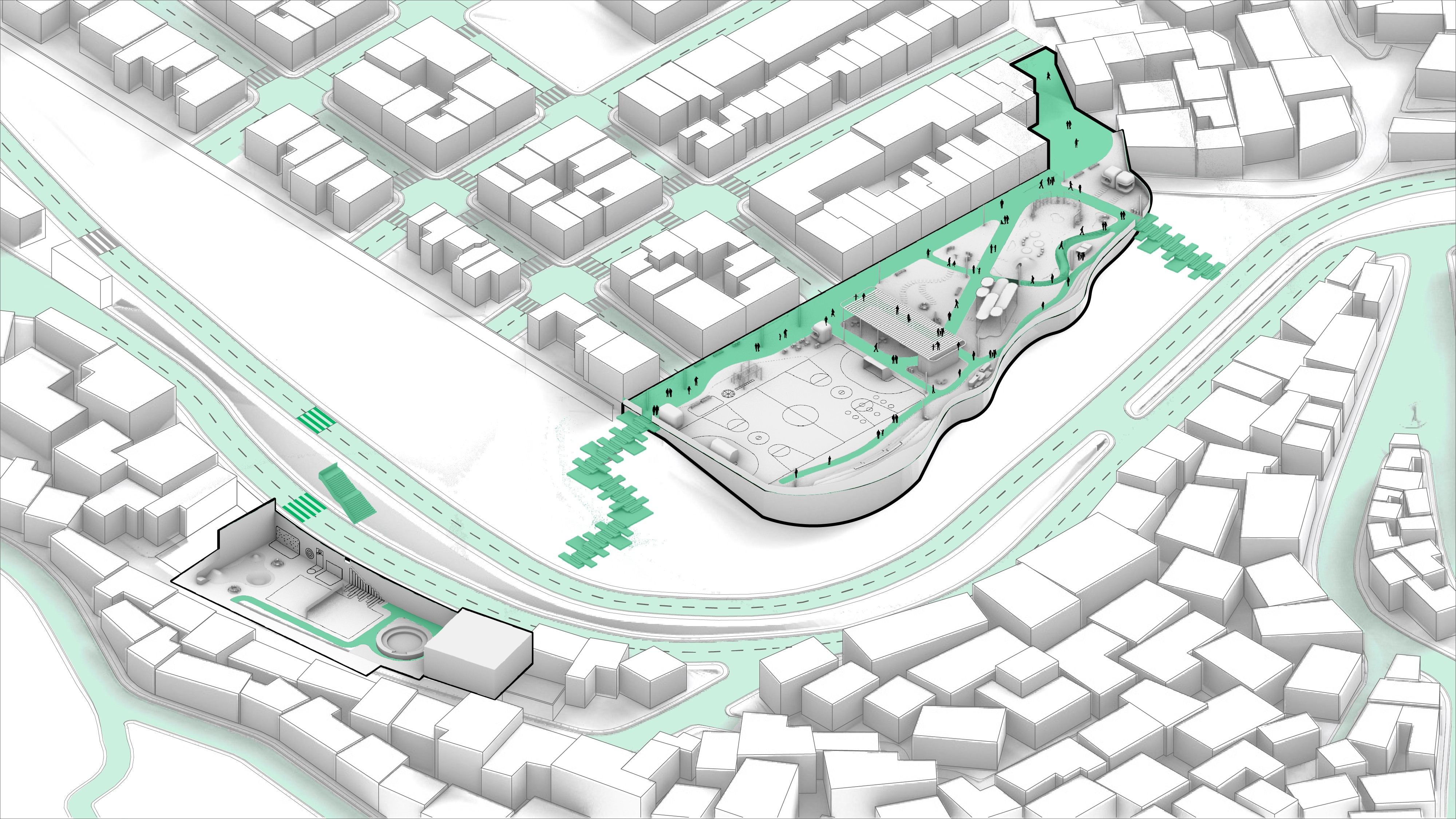
Our analysis led us to identify two priority nodes and one strategic street link where Melilla in Motion could generate the greatest impact. La Cañada emerged as a critical first site : a vulnerable, physically isolated hillside neighbourhood where public space feels uninviting, under-equipped and disconnected from daily life.
Voices like Halima’s, a grandmother who rarely felt able to leave her home, revealed how environmental neglect creates social exclusion.
Activation
Connection
Inclusion
TAILORED SPATIAL PROGRAMMES
Each selected node receives a tailored spatial and programmatic strategy. Rather than replicating one design across the city, we adapt the Human-Centric Programme, architectural language, public space elements to the specific needs, cultures and patterns of each place.
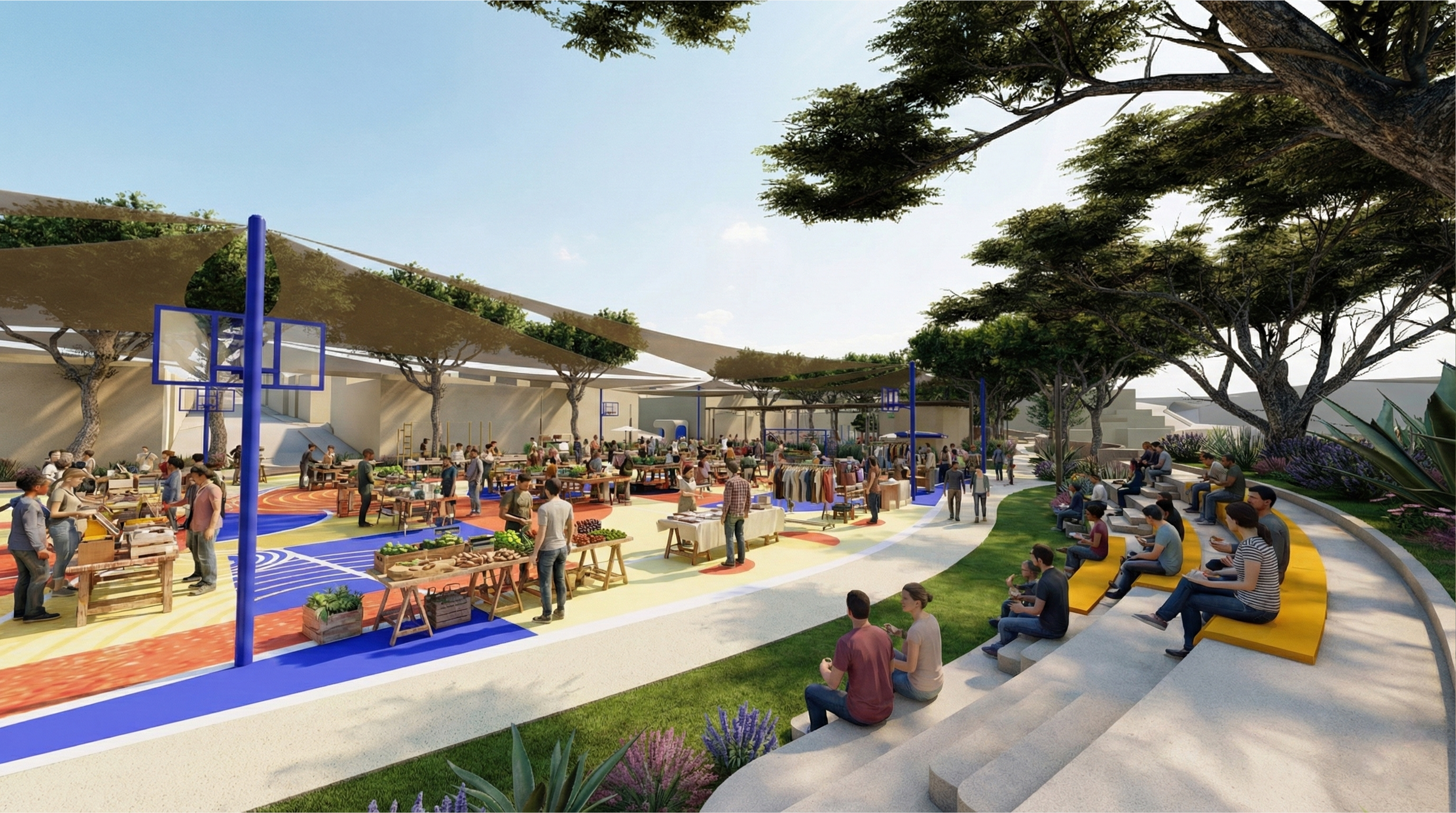
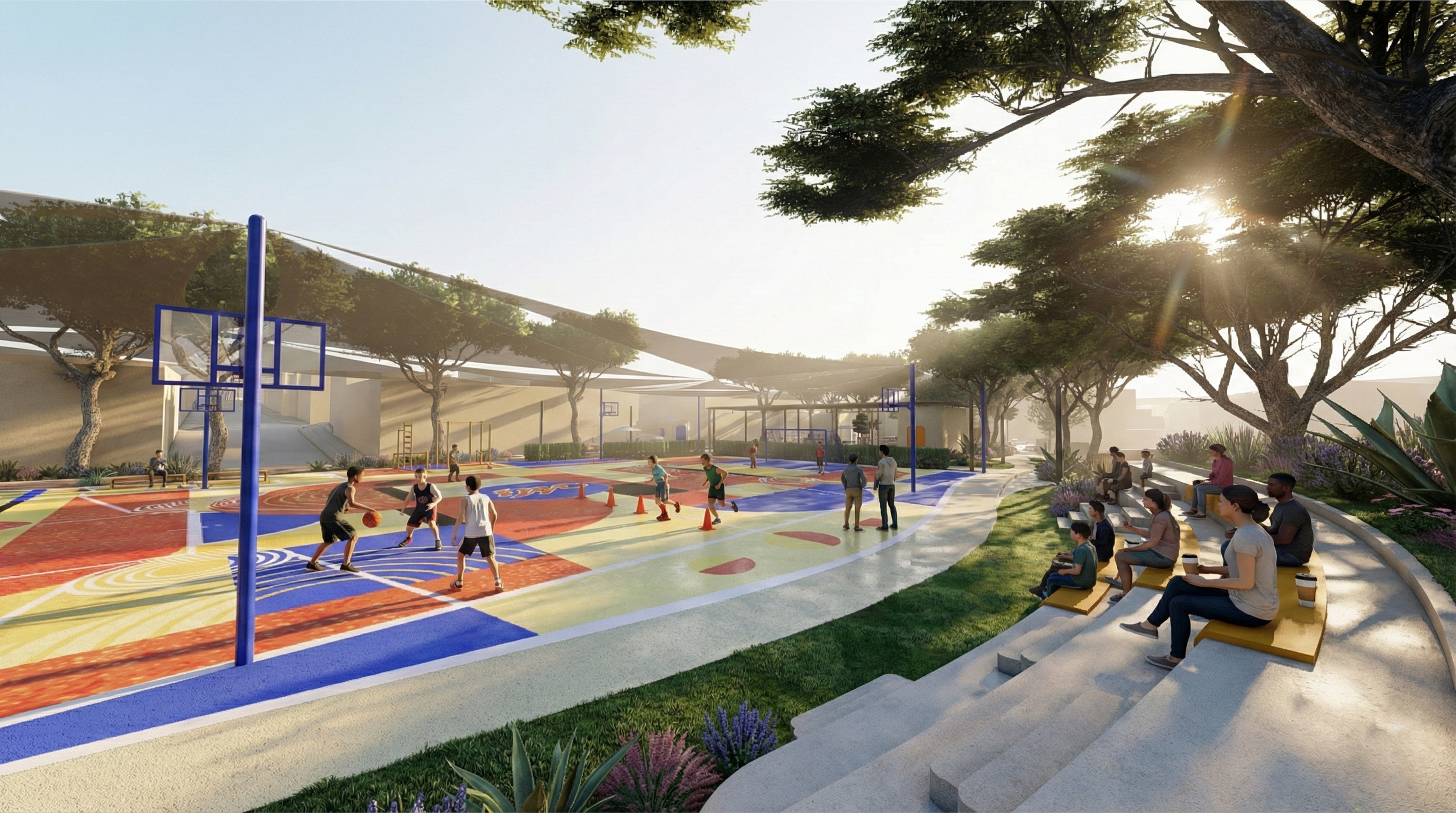
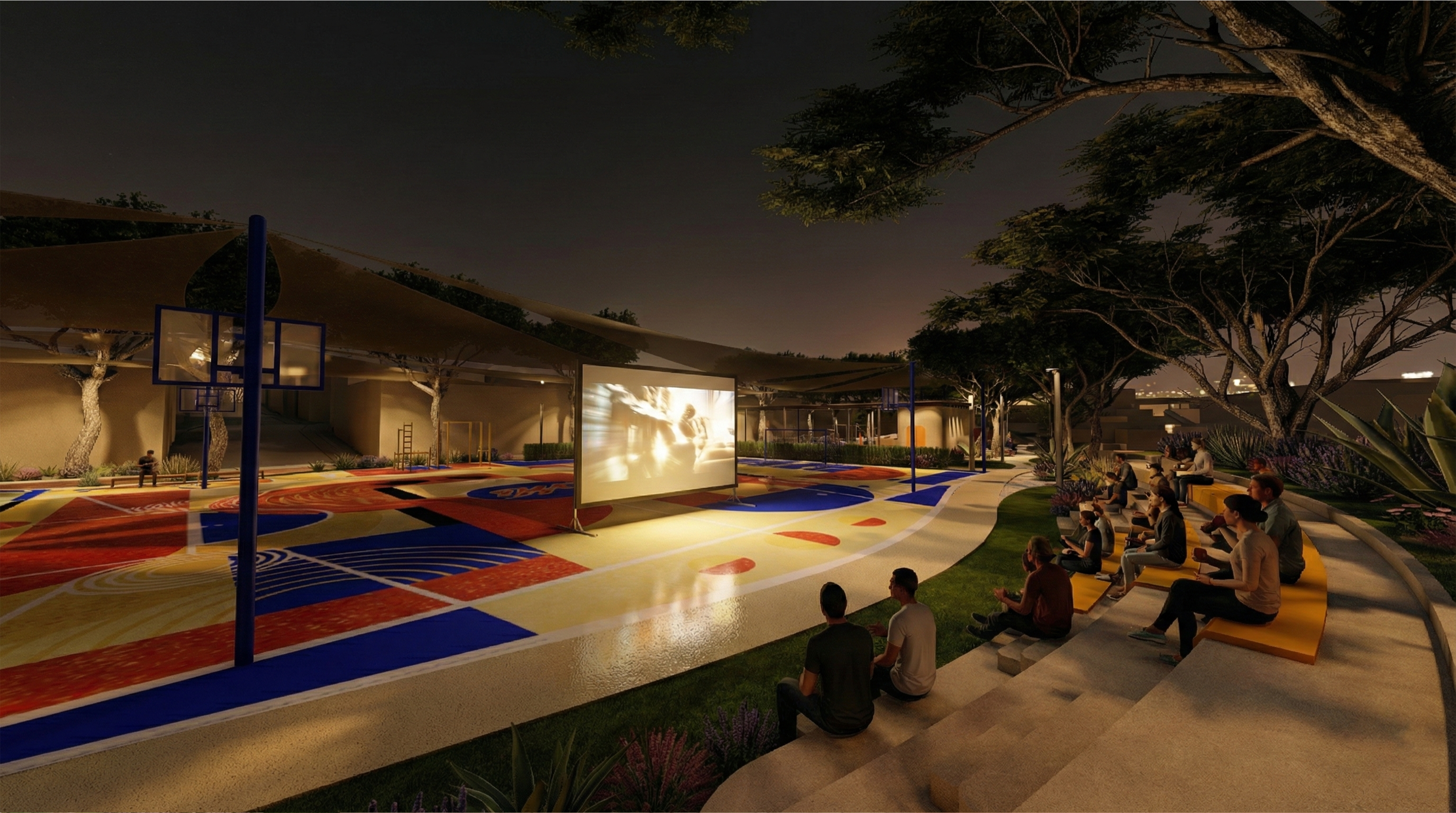
La Cañada integrates a food market, shaded gathering areas and multi-use platforms; other nodes may include makerspaces, afterschool sports structures or spaces for festivals and intergenerational activities. This tailored approach ensures that every intervention strengthens its immediate community while contributing to a cohesive, city-wide network of connected, active and inclusive public spaces.
DESIGN INTERVENTION
Urban Design for Skills and Community
The urban design intervention allocates infrastructure for the sports for development programme, where children and youth can develop skills to thrive, playgrounds where they can start making friends while adults can also enjoy the space learning, talking and using the space.
Flexibile areas that activate economy & connection
Public space is about activating the local economy, and this can happen by having open areas that can host temporary markets for local vendors to sell their products, craftsmanship and promote their work. With adequate public infrastructure these places can become lively meeting points.
Urban Furnitures
I.
Research & sketches
II.
Street INTERVENTION
Improving the network infrastructure not only enhances accessibility and urban continuity, but also supports Melilla’s transition toward a more caring, inclusive and people-centred urban environment.
CITY SIZE IN KM
WALKING TIME IN HOUR
SPORT’S INFRASTRUCTURES
12
35
1:40
The design and implementation of a mobility network is essential for enabling and facilitating movement between the nodes and, ultimately, across the entire city. Improving the network infrastructure not only enhances accessibility and urban continuity, but also supports Melilla’s transition toward a more caring, inclusive and people-centred urban environment.
Based on the spatial configurations proposed in the Urban Design Catalogue, the street interventions aim to prioritise pedestrians in the public space and offer multimodal accessibility. The objective is to transform Melilla into a walkable city while creating flexible streets capable of accommodating community-oriented uses such as Sunday street activations, open-air markets and cultural events, while reinforcing social cohesion.
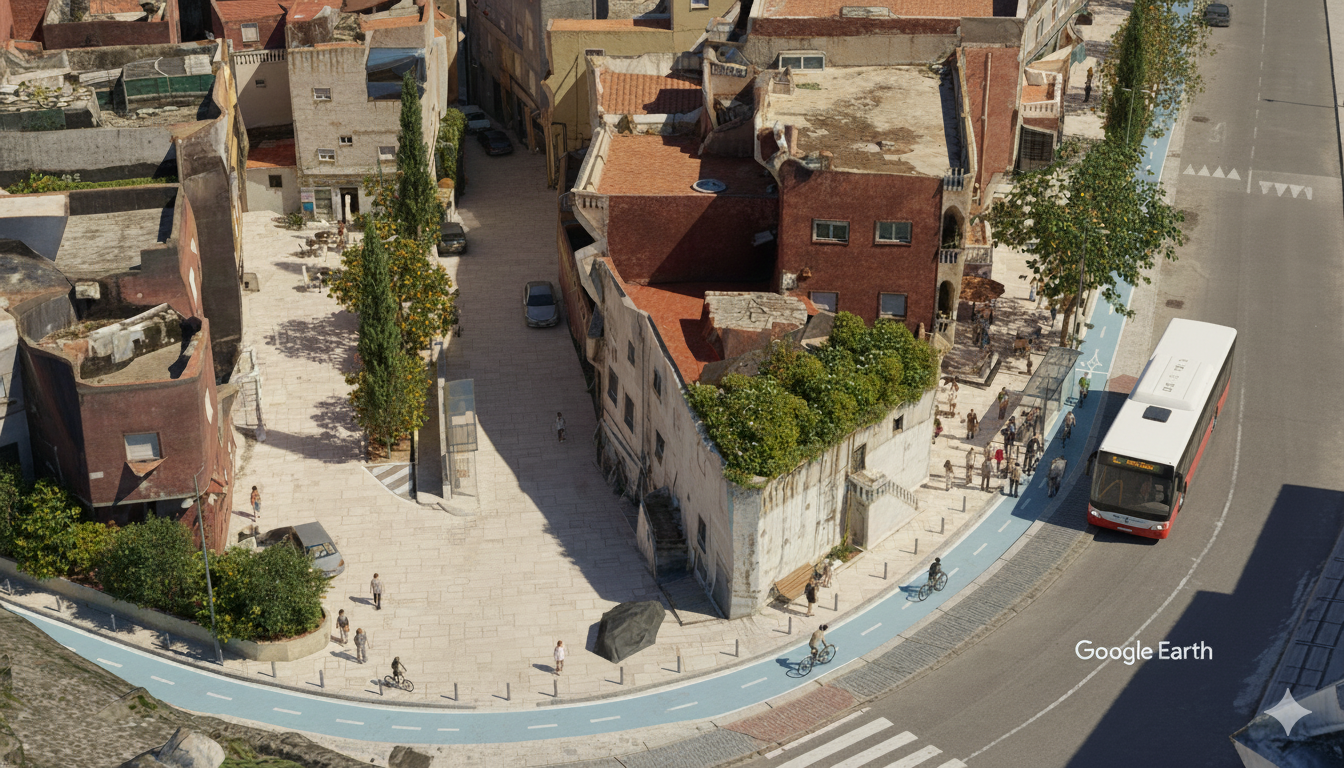
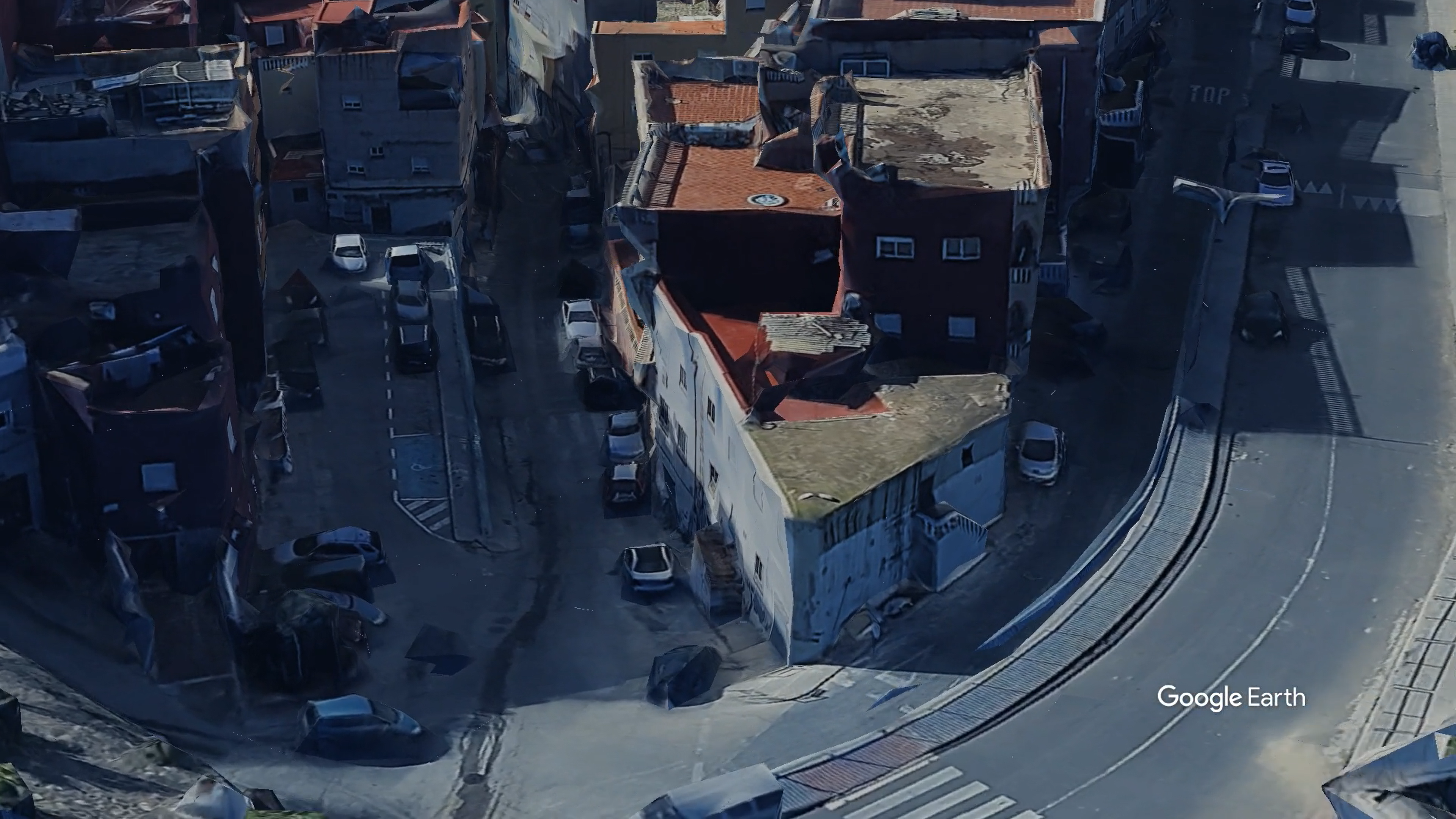
C. CASIOPEA
For the narrow streets of La Cañada de Hidum, the proposal introduces a shared-street design where pedestrians, cyclists, and vehicles coexist safely at low speeds. Green infrastructure, through planters, façade vegetation, and reclaimed parking spaces, softens the dense context. Upgraded bus stops and cycling connections improve access between the neighbourhood and the city.
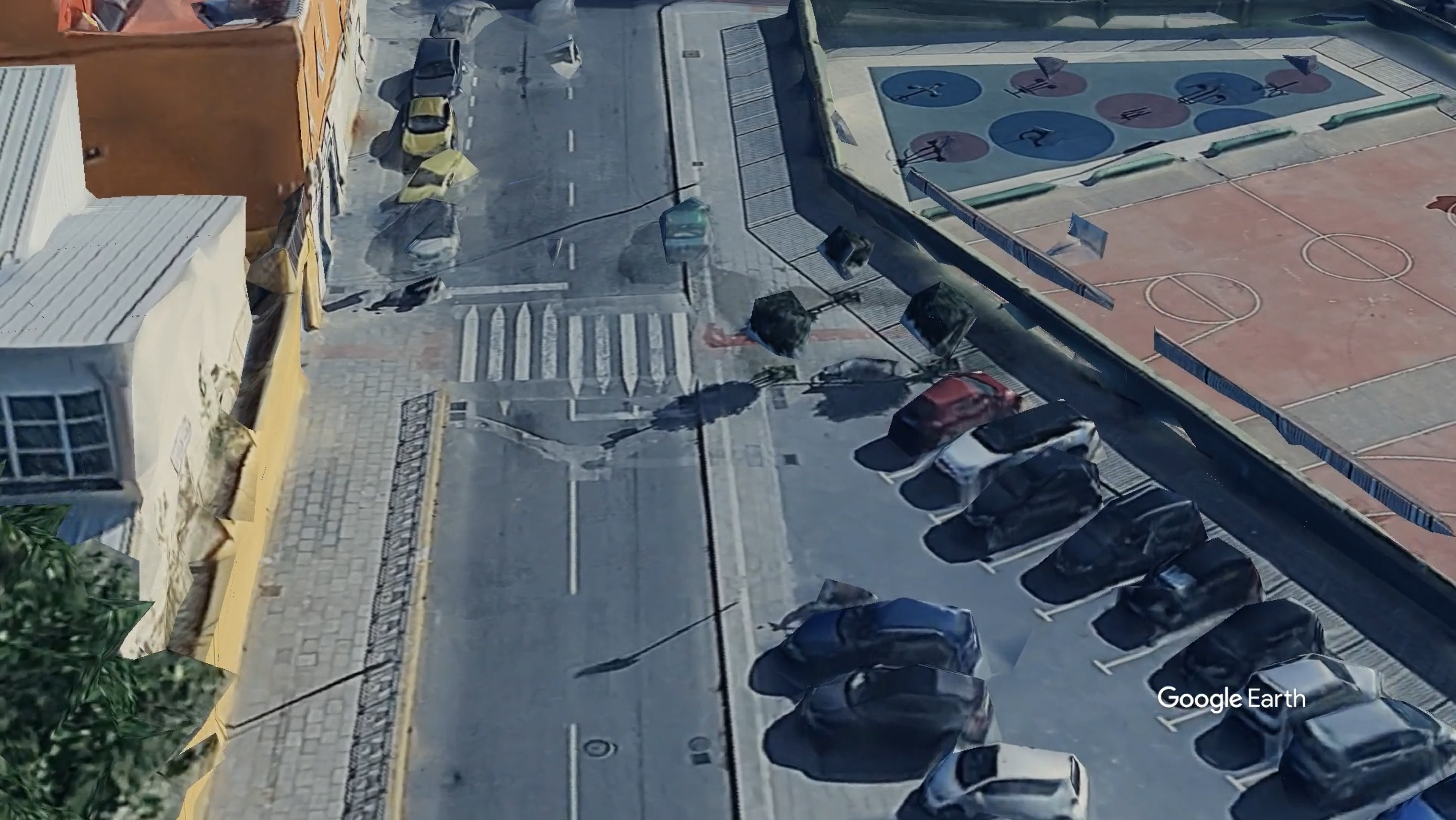
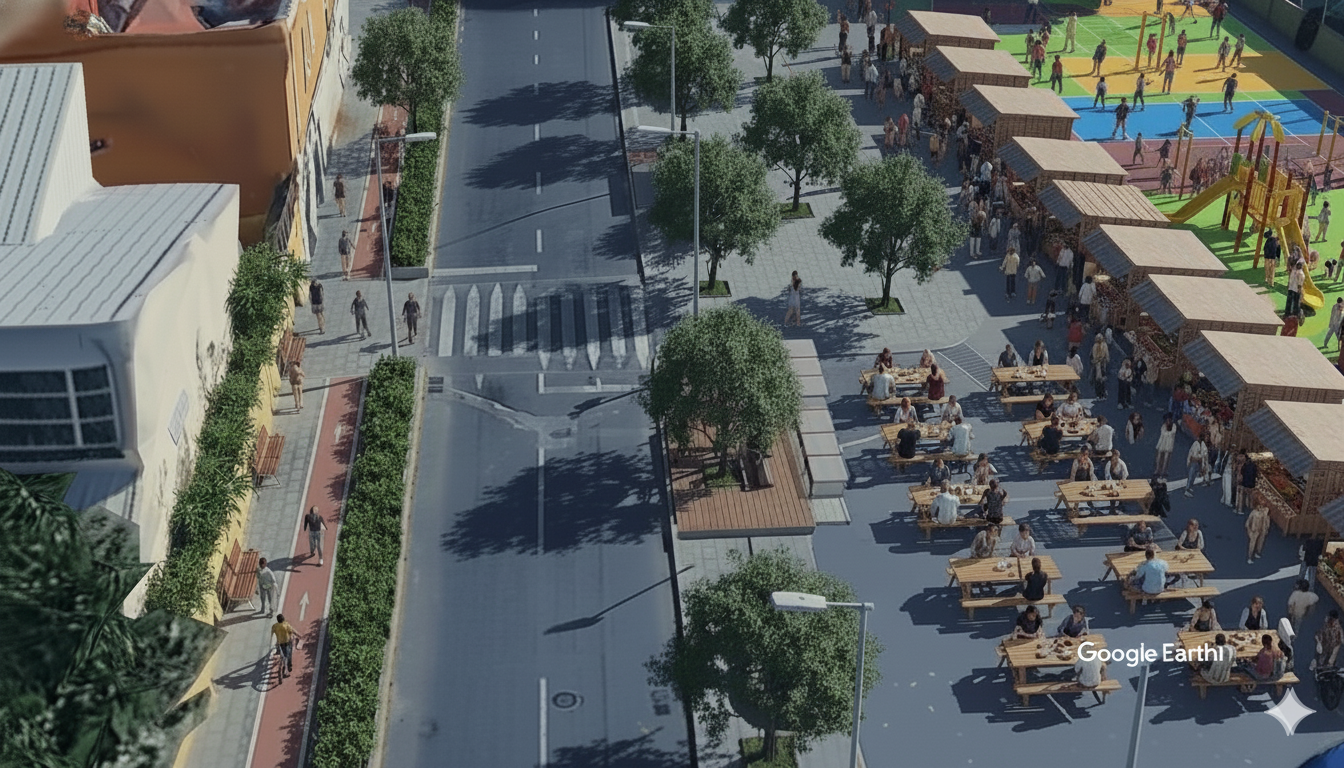
CTRA. HIDUM (Ctra. Hidum)
The intervention on Ctra. Hidum strengthens the link between La Cañada and Las Palmeras by transforming the street into an active, pedestrian-focused corridor. Wider shaded sidewalks, parklets and permeable surfaces improve comfort and environmental performance, while a protected, vegetation-buffered cycle lane ensures safe mobility. Flexible-use areas enable street markets and community activities under a continuous Mediterranean tree canopy.
CARLOS RAMÍREZ DE ARELLANO
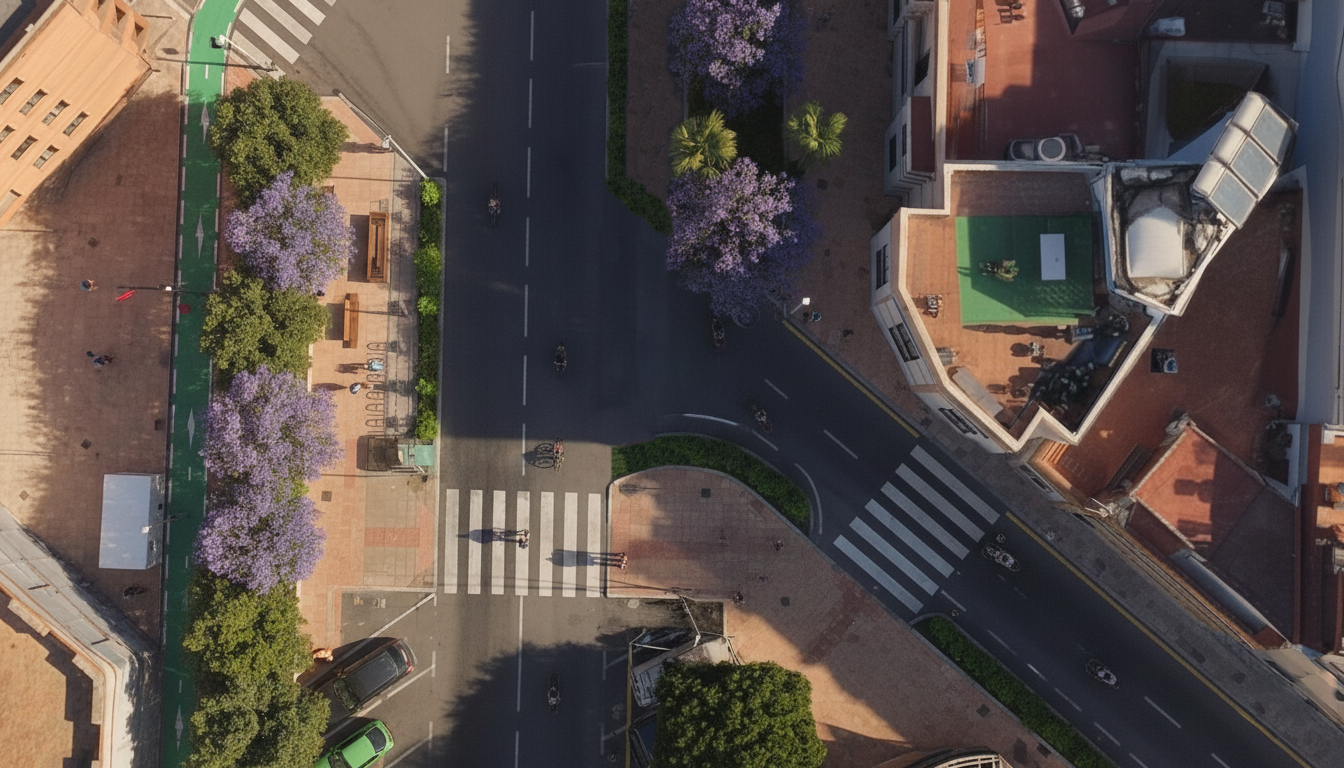
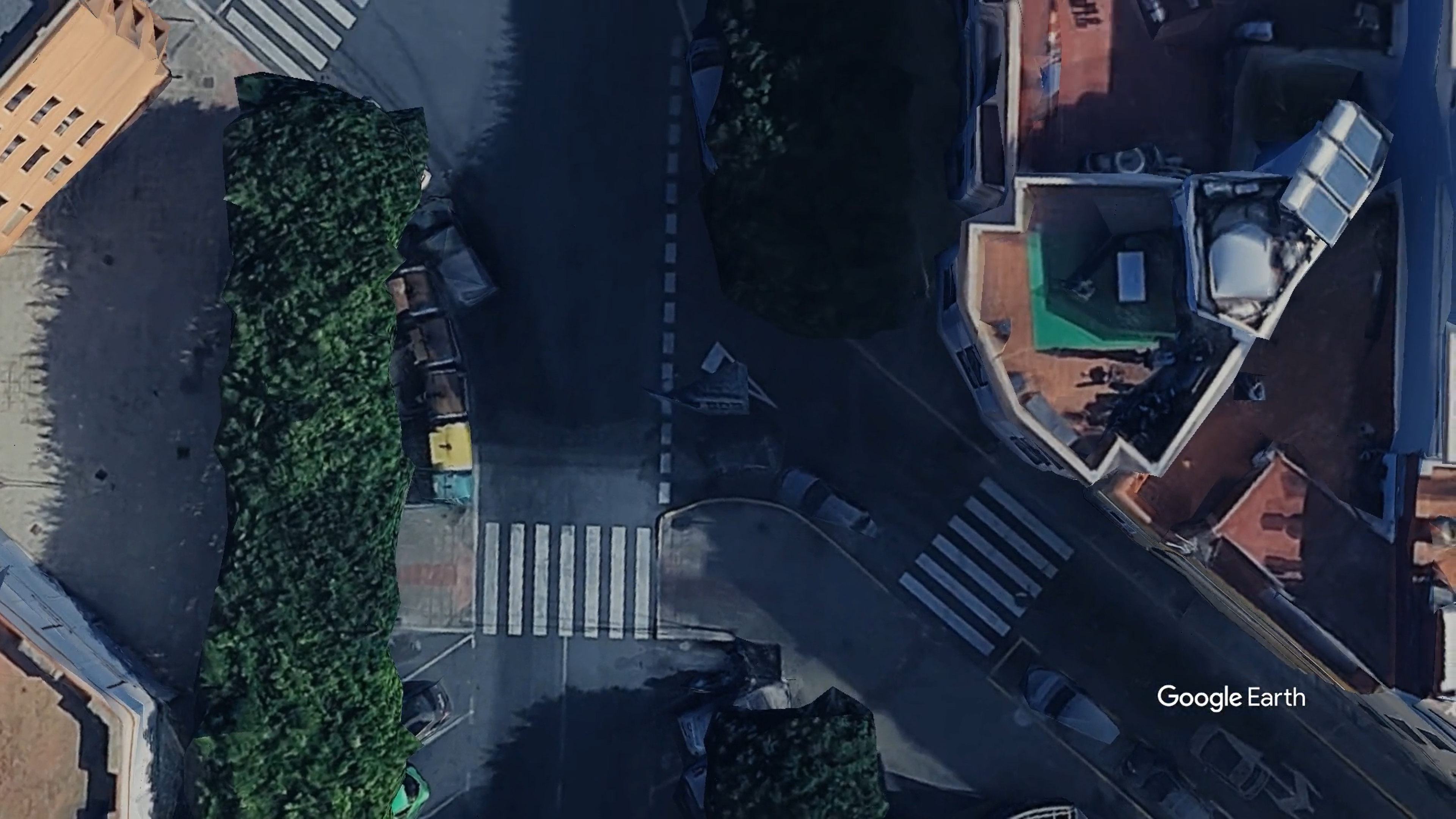
This proposal reorganises the street to enhance its social and mobility function. Parklets provide spaces for rest and interaction, while redesigned pedestrian crossings increase safety and visibility. A protected, shaded cycle lane completes a multimodal corridor that encourages active travel and strengthens neighbourhood connectivity.



MELILLA IN MOTION is a civic design project developed at the Norman Foster Institute by a stellar team of seven, drawn from diverse backgrounds across the world.
Melilla is a European city on North African soil, a plural society of five communities living side by side, fractured by isolated neighbourhoods and uneven access to public life. Melilla in Motion reimagines it as a Caring City, using Play as the common ground every community already shares.
Through a data-driven prioritisation engine, participatory co-design, city-wide branding as civic infrastructure, and tailored urban interventions, the project turns sport and public space into instruments of cohesion — extracted from Melilla, written in its own hand, and handed back to the people who will keep it alive.
THE CARING CITY
A caring city is one that looks after itself and its people, where daily life meets a practice of mutual diligence, as people, buildings and public spaces sustain one another through presence. Care is not only confined to institutions, but woven into the everyday encounters. While a coherent urban structure helps citizens find their way in movement, it is the public space that invites connection, interaction and cordiality between the people regardless of their background, beliefs, or gender identity. The works of famous urbanists, such as Jane Jacobs, David Lynch, Juliet Davis, have inspired outlining a framework for cities that are safe, inclusive and intelligible.
For Melilla, we imagine the city as a living embodiment of these ideas, coupled with our vision of a social catalyst that brings communities together, encouraging movement, dialogue and solidarity. Inspired by Melilla’s diverse identity, institutional priorities and its rich network of public sports facilities, Melilla in Motion (Melilla en Movimiento) seeks to address the challenges impeding integration and progress, while cultivating a culture of care that strengthens the city’s future.
GEO-INTELLlGENCE
Effective urban interventions begin with a deep understanding of context. Building on open-source data, insights from community workshops, the immersive site visit and spatial analytics, we developed the Node Assessment Tool to evaluate the condition and potential of Melilla’s sports infrastructure. The tool consolidates qualitative and quantitative findings into a clear set of Key Performance Indicators (KPIs),
enabling the team to measure, compare and prioritise sites with precision. They are visualised in a three-page dashboard structured around three strategic pillars: Inclusion, Activation, Connection. Users can select any sport facility to view its scores, compare multiple sites and explore spatial relationships across the city through maps and bar charts.
Activation
Consolidates the scores of each sport facility based on the KPIs: Vulnerability, Access to Public Open Space and Population Served.
Connection
Quantifies the KPI scores from Network Analysis based on Hillier Centrality Values, Choice Global / Local Streets and Accessibility to various services and public amenities.
Inclusion
Provides quantitative scores for the physical quality of the sports facility and its surroundings, including median thermal comfort, safety perception based on visibility and usage based on the city's yearly calendar of activities.
578
DATA GATHERED IN GIGABYTES
12.3
CITY SIZE IN KM2
DENSITY / SQUARE KM2
WALKING TIME IN HOUR
7k
1:40
CIVIC-TECH
THE FIRST PIECE OF CIVIC INFRASTRUCTURE MELILLA RECEIVED WAS NOT PHYSICAL, BUT A TOOL, ONE THAT ALLOWS THE CITY TO DECIDE, AT SCALE, WHAT IS WORTH BUILDING AT ALL. A DATA-DRIVEN PRIORITIZATION ENGINE REPLACES POLITICAL INTUITION WITH CIVIC EVIDENCE, TRANSFORMING URBAN DECISION-MAKING INTO A TRANSPARENT, DEFENSIBLE ACT OF DESIGN.
Each pillar is evaluated through a series of innovative KPIs that translate complex datasets into actionable insights for site selection and prioritisation.
Measuring Activation
I.

Measuring Inclusion
II.
Measuring Connection
III.
To ensure that Melilla’s new sports and public spaces remain active, welcoming and socially meaningful, a series of Human-Centric Programmes has been developed. These initiatives include: Sports for Development (safe, structured sport activities supporting vulnerable youth), Makerspaces & Workshops (shared spaces for craft, repair and creative collaboration) and Time-Bank Exchanges (community-led systems for exchanging skills, care and support).
Each programme is designed to be easy to implement and is delivered through clear, multilingual booklets (Spanish and Arabic) that guide municipalities, educators and local associations.
36.5
AVERAGE AGE Y/O
YOUTH UNEMPLOYEMENT
36%
SCHOOL DROPTOUT YOUTH POP.
26%
UNDER 29 Y/O
34%
Human-centric programMES
In melilla our H.C.P are interventions designed around the daily lives, dignity, and agency of residents; treating public space, mobility and services as instruments of social cohesion rather than infrastructure delivery
SPORTS FOR DEVELOPMENT BECOMES a tool for protection, well-being and opportunity. Through after-school sessions, community sport groups, mentorship and vocational pathways, the programme uses play as an accessible entry point for young people.
The Sports for Development Guidance Note is a practical resource for the city administration, outlining how sport can be structured as a pathway to development, protection and wellbeing for young people in Melilla. It gathers clear steps for programme design, beneficiary identification & neighbourhood implementation, supported by tools, good practices and global examples.
Alongside this, the note highlights a range of funding avenues, from EU inclusion and urban innovation programmes to national and philanthropic grants—helping the municipality translate sports activities into a coordinated, city-wide strategy for youth inclusion and community cohesion.
PARTICIPATIVE WORKSHOPS
During our site visit, two participatory workshops were held to understand the needs, priorities and daily realities of Melilla’s residents. These sessions were our first experience with co-design and they became a defining part of the process.
By listening directly to the people who live the city every day, we were able to ground our work in real voices, real concerns and real aspirations.
These workshops, developed through the NFI, created a space for dialogue and collaboration. This ensured that the project reflected not only a vision for the city, but also the communities who will shape and inhabit its future.
BRANDING AT THE CIVILIZATIONAL SCALE
branding acts as civic infrastructure: a shared visual language, drawn from Melilla's own heritage, that makes belonging legible across every public space. Its role is not to brand a city, but to give a plural city the common grammar through which all its communities can claim it together.
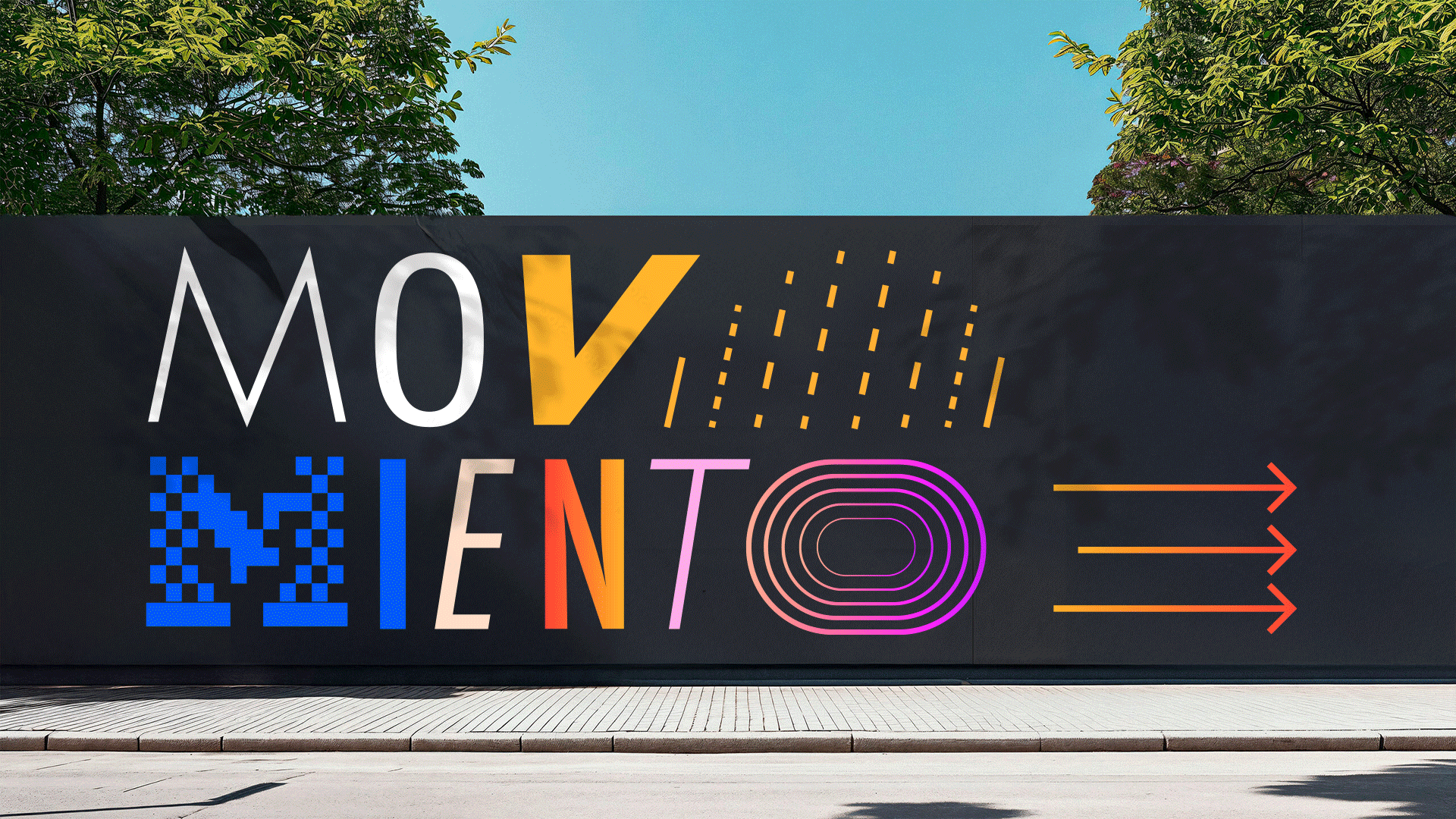
and grammar, wayfinding its plain public voice, the letter-shaped forms its inhabitable body, and the participatory workshops the means by which residents become its native speakers. Extracted from Melilla, written in its own hand, and handed back to the people who will keep it alive.
Melilla in Motion is not a brand applied to a city but a language designed for one. Its content is Play: the commons a plural city already shares, asking nothing of language, faith or origin.
The system has six registers and they are one thing: the sports fields are its source, Melilla Antique its script, geometry and colour its vocabulary
DESIGNING THE LANGUAGE OF PLAY
Pictograms as a universal language.
Sports fields draw geometry onto the ground : circles, grids, boundaries, arcs
and directional lines.
Sport’s fields
I.
Tailored Typeface
II.
Wayfinding System
III.
Curating Melilla In Motion
IV.
URBAN INTERVENTION
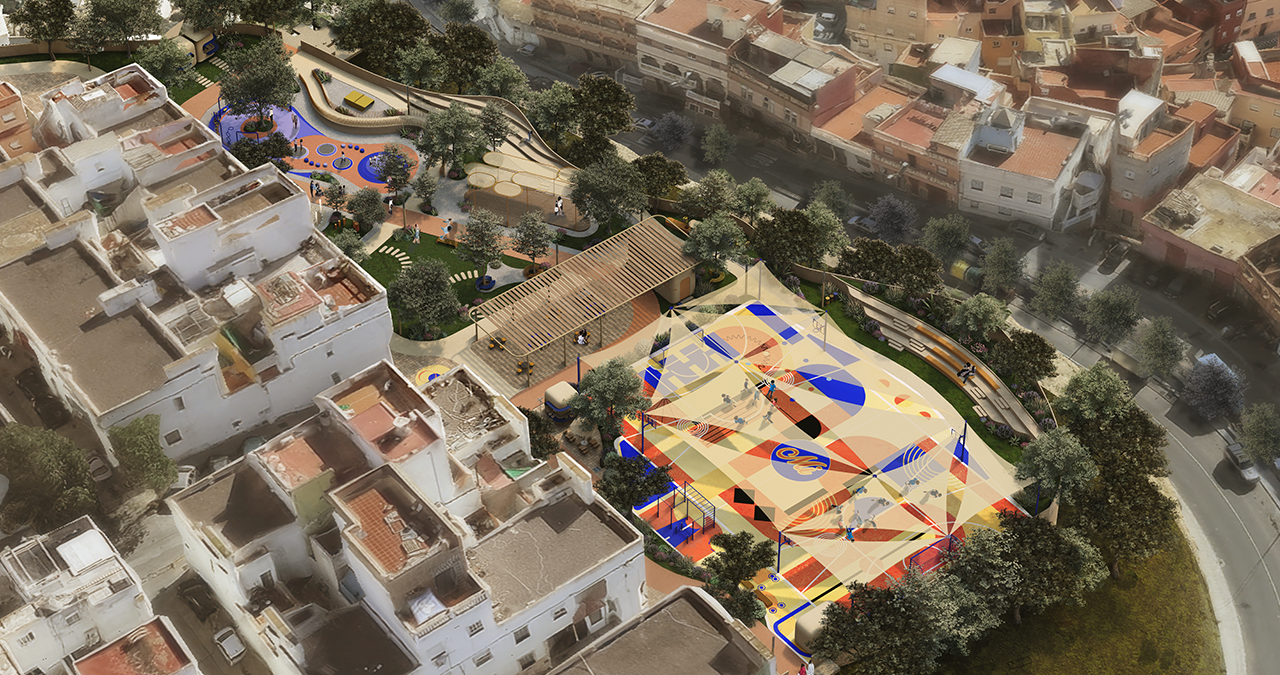
The urban design process takes into consideration the existing sports infrastructure that the city has previously invested in, by introducing diverse public space infrastructure to reinforce local engagement and space vibrancy.
17
WALKING TIME IN MN
BEFORE INTERVENTION:
WALKING TIME IN MN
AFTER INTERVENTION:
5
Our analysis led us to identify two priority nodes and one strategic street link where Melilla in Motion could generate the greatest impact. La Cañada emerged as a critical first site : a vulnerable, physically isolated hillside neighbourhood where public space feels uninviting, under-equipped and disconnected from daily life.
Voices like Halima’s, a grandmother who rarely felt able to leave her home, revealed how environmental neglect creates social exclusion.
Activation
Inclusion
Connection
La Cañada integrates a food market, shaded gathering areas and multi-use platforms; other nodes may include makerspaces, afterschool sports structures or spaces for festivals and intergenerational activities. This tailored approach ensures that every intervention strengthens its immediate community while contributing
to a cohesive, city-wide network of connected, active and inclusive public spaces.
Each selected node receives a tailored spatial and programmatic strategy.
Rather than replicating one design across the city, we adapt the Human-Centric Programme, architectural language, public space elements to the specific needs, cultures and patterns of each place.
TAILORED SPATIAL PROGRAMMES
II. Flexibile areas that activate economy & connection.
Public space is about activating the local economy, and this can happen by having open areas that can host temporary markets for local vendors to sell their products, craftsmanship and promote their work. With adequate public infrastructure these places can become lively meeting points.
I. Urban Design for Skills and Community.
The urban design intervention allocates infrastructure for the sports for development programme, where children and youth can develop skills to thrive, playgrounds where they can start making friends while adults can also enjoy the space learning, talking and using the space
DESIGN INTERVENTION
Urban Furnitures
I.
Research & sketches
II.
Street INTERVENTION
Improving the network infrastructure not only enhances accessibility and urban continuity, but also supports Melilla’s transition toward a more caring, inclusive and people-centred urban environment.
12
CITY SIZE IN KM
SPORT’S INFRASTRUCTURES
WALKING TIME IN HOUR
35
1:40
Based on the spatial configurations
proposed in the Urban Design Catalogue, the street interventions aim to prioritise pedestrians in the public space and offer multimodal accessibility. The objective is to transform Melilla into a walkable city while creating flexible streets capable of accommodating community-oriented uses such as Sunday street activations, open-air markets and cultural events, while reinforcing social cohesion.
The design and implementation of a mobility network is essential for enabling and facilitating movement between the nodes and, ultimately, across the entire city.
Improving the network infrastructure not only enhances accessibility and urban continuity, but also supports Melilla’s transition toward a more caring, inclusive and people-centred urban environment.
For the narrow streets of La Cañada de Hidum, the proposal introduces a shared-street design where pedestrians, cyclists, and vehicles coexist safely at low speeds. Green infrastructure, through planters, façade vegetation, and reclaimed parking spaces, softens the dense context. Upgraded bus stops and cycling connections improve access between the neighbourhood and the city.
C. CASIOPEA
The intervention on Ctra. Hidum strengthens the link between La Cañada and Las Palmeras by transforming the street into an active, pedestrian-focused corridor. Wider shaded sidewalks, parklets and permeable surfaces improve comfort and environmental performance, while a protected, vegetation-buffered cycle lane ensures safe mobility. Flexible-use areas enable street markets and community activities under a continuous Mediterranean tree canopy.
CTRA. HIDUM (Ctra. Hidum)
This proposal reorganises the street to enhance its social and mobility function. Parklets provide spaces for rest and interaction, while redesigned pedestrian crossings increase safety and visibility. A protected, shaded cycle lane completes a multimodal corridor that encourages active travel and strengthens neighbourhood connectivity.
CARLOS RAMÍREZ DE ARELLANO
© 2025-2026 NORMAN FOSTER INSTITUTE